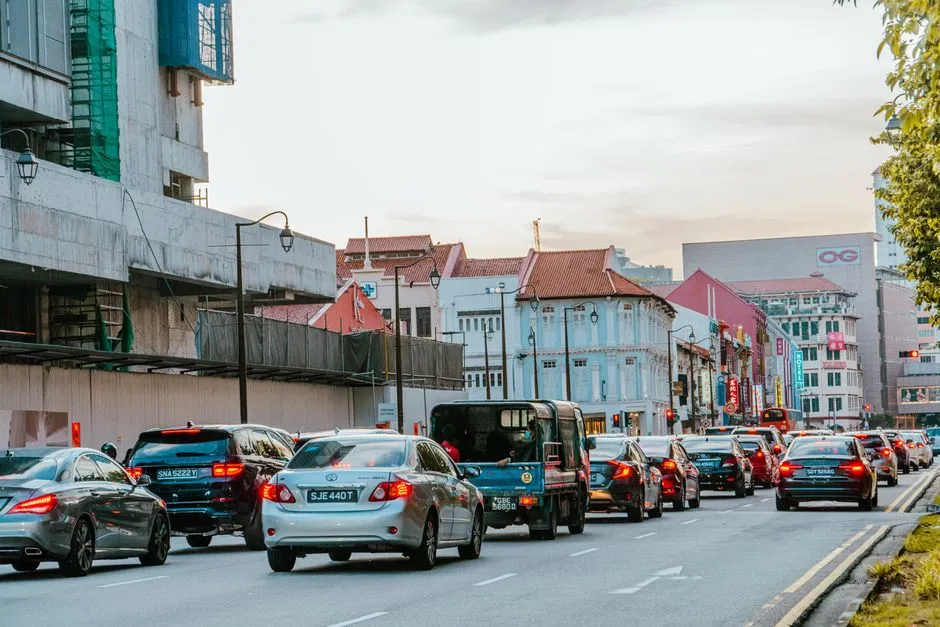
Closer than in the first nine months of any year after 2018, Singapore's Category A and Category B COE premiums finished a median S$2,750 apart over the 18 bidding exercises from January to September 2026, by our count of results published by the Land Transport Authority (LTA). B closed a median 2.2% above A, and below it three times. Each price is the highest unsuccessful bid plus S$1, paid by every winner in the category, and renewing costs the average of the last six results, rounded up. The first September 2026 exercise set S$133,009, the highest Category A premium in LTA's published series, which starts in 2002.
A certificate of entitlement, 拥车证 in Singapore's Chinese press, is the right to keep a vehicle on Singapore's roads for ten years; Malaysia, Hong Kong and Taiwan have no equivalent. Results are from LTA's data.gov.sg datasets, updated 23 September 2026, and figures are as of the second September 2026 exercise unless another is named. The next exercise usually closes on Wednesday 7 October.
A winning bidder pays the highest losing bid plus a dollar
Bidding usually runs twice a month, from noon on the first and third Monday to 4 pm that Wednesday. LTA's COE page defines the running price as "the price of the highest unsuccessful bid plus $1", and the figure at the close is what every successful bidder in the category pays. Unsold certificates pass to the corresponding exercise of the following month, which is why the quota in LTA's results data runs above the announced quota.
Small-car certificates fetched nearly the large-car price in 2026
The split may not last. Of its review of the car categories, the transport ministry said in a written parliamentary reply on 6 May 2026: "We expect to conclude the review by the end of this year." Acting Minister for Transport Jeffrey Siow announced the review at the Committee of Supply debate on 4 March 2026, telling Parliament that a power limit had been added in 2014 to separate the categories and that, more recently, "manufacturers have been adjusting specifications of cars to fit within Category A".
Category A now covers non-electric cars up to 1,600cc and 97 kW, and fully electric cars up to 110 kW from the first May 2022 exercise; Category B takes cars above either limit. A closed above B in the second exercises of February, April and June 2026, by S$1,500, S$2,009 and S$345, the first times since 2020. Of the 16 January-to-September stretches from 2010 to 2025, only 2018's was closer, at 1.5%, though the definitions changed in 2014 and 2022.
Category A buyers bid higher while the quota more than doubled
By LTA's announced figures, Category A's quota for May to July 2026, 7,434 certificates, was 2.45 times the 3,032 of February to April 2023, and the current quarter's 7,134 is 2.35 times. Category B went from 5,205 to 5,527 between those two 2026 quarters. Meanwhile the mean Category A premium rose 36%, from S$92,380 in February to April 2023 to S$125,646 in May to July 2026, by our averages of LTA's results. The ministry's May reply said Category A supply peaked in the fourth quarter of 2025.
A renewal costs the average of the last six results, rounded up
LTA's renewal page defines the prevailing quota premium (PQP) as "the moving average of the Quota Premiums (QPs) in the last 3 months where bidding exercises were conducted". LTA states a rounding rule only for the five-year payment, but by our check the six-result mean, rounded up, matches all 1,172 PQPs LTA published for Categories A to D from 2002 to 2026, where plain rounding matches 163 to 173 per category.
The same rule reproduces LTA's October 2026 PQPs to the dollar: A S$128,715, B S$131,616, C S$92,614 and D S$11,161, as printed in LTA's 2025–2026 results table. A ten-year renewal pays the full PQP and a five-year one half, rounded up: S$64,358 for Category A in October, on our arithmetic. Category A, B and D vehicles may take the five-year option only once.
Our calculator billed older cars for a fee tier that came later
Our COE, ARF and PARF calculator matched our own implementation of LTA's tables in all 439,566 comparisons for the three rule sets it modelled, and missed the fourth. Until 2 October 2026 it gave every certificate from before the second February 2023 exercise a 220% ARF tier that only began with the second February 2022 exercise, overstating the oldest certificates' ARF by S$8,000 at an OMV of S$100,000. It also based Category E rebates on the full E premium, ran goods vehicles through the car tables, and denied PARF at exactly ten years. The fix made on 2 October 2026 covers all of this, with 0 mismatches in 586,088 comparisons; the live page may show the old version until it is deployed.
A car deregistered at exactly ten years still collects a PARF rebate
The COE rebate is the premium paid times the unused share of the 120 months. The PARF rebate, a share of the Additional Registration Fee (ARF), is paid while the car is "not more than 10 years old", so the last band still applies at exactly ten. LTA works it on the net ARF after VES, CEVS and similar rebates, and a car once laid up does not qualify. Each revision follows the exercise the certificate came from, per LTA's releases of February 2022, February 2023 and February 2026:
| COE obtained | ARF on OMV | PARF schedule |
|---|---|---|
| Before the 2nd Feb 2022 exercise | 100%, 140%, then 180% above S$50,000 | 75% to 50%, no cap |
| 2nd Feb 2022 to 1st Feb 2023 | Adds 220% above S$80,000 | 75% to 50%, no cap |
| 2nd Feb 2023 to 1st Feb 2026 | 100% to 320% in S$20,000 bands | 75% to 50%, capped at S$60,000 |
| 2nd Feb 2026 onwards | As above | 30% to 5%, capped at S$30,000 |
Below an OMV of about S$56,800, the 2026 schedule cut the rebate by 60% within five years and 90% in the final band; where the old S$60,000 cap applied, the five-year rebate exactly halved. That is our arithmetic; LTA's rebate enquiry, using the car's net ARF and exact dates, is the authority. Road tax and a worked example are in what a car costs to own in Malaysia and Singapore.
An open-category certificate refunds no more than the car's own category premium
Category E, open to all but motorcycles, reached S$158,004 and B S$150,001 in the second October 2023 exercise, above any Category A result. From then to September 2026, E closed below B in 26 of 72 exercises and never below A. Past results say nothing about the next exercise, and E certificates have their own rules: an individual's C or E certificate can be transferred once, where A, B and D certificates cannot, and the rebate is worked on the lower of the E premium paid and the vehicle's own category premium in the same exercise. In the second September 2026 exercise E closed at S$137,000 and A at S$131,890, so a Category A car on an E certificate from it has its rebate worked on S$131,890.
Contains information from COE Bidding Results / Prices accessed on 2 October 2026 from data.gov.sg which is made available under the terms of the Singapore Open Data Licence version 1.0 https://data.gov.sg/open-data-licence
Contains information from Motor Vehicle Quota, Quota Premium And Prevailing Quota Premium, Monthly accessed on 2 October 2026 from data.gov.sg which is made available under the terms of the Singapore Open Data Licence version 1.0 https://data.gov.sg/open-data-licence

View author profile → · Editorial policy