
Our own tuition calculator will tell you a four-year degree costs $54,400. It is not wrong. It is answering a narrower question than the one most people think they are asking, and it says so — in a sentence almost nobody reads.
Under the result it lists what the figure excludes: books, housing, living costs, scholarships, financial aid, and fee changes between years. That last clause is the one that moves the number. We computed what it costs.
The number the tool gives, and the number it stands behind
Feed the calculator its own default figures — $400 a credit, 15 credits a term, $800 of fees a term, eight terms — and it returns a total of $54,400. That is a multiplication: one term's cost, times the number of terms.
Which is exactly right, provided a term in year four costs what a term in year one did. Fees generally do not work that way.
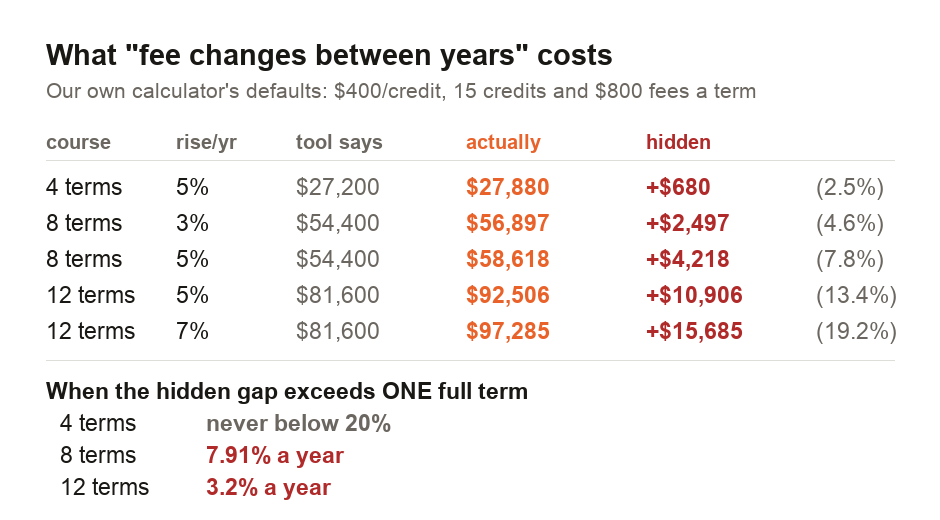
So we took the same eight terms and let the per-term cost rise once a year, using the calculator's own per-term figure as the starting point rather than re-deriving it. At a 5% annual rise the same degree comes to $58,618.
| Course length | Annual rise | Tool's total | With escalation | Difference |
|---|---|---|---|---|
| 4 terms (2 years) | 5% | $27,200 | $27,880 | +$680 (2.5%) |
| 8 terms (4 years) | 3% | $54,400 | $56,897 | +$2,497 (4.6%) |
| 8 terms (4 years) | 5% | $54,400 | $58,618 | +$4,218 (7.8%) |
| 12 terms (6 years) | 7% | $81,600 | $97,285 | +$15,685 (19.2%) |
The gap is $4,218 on a standard four-year course at a modest rate. On a six-year path at 7% it is $15,685, or 19.2% — most of an extra year.
Why a small rate makes a large hole
Two effects stack here, and the second one is easy to miss.
The obvious one is that each year's fee is a percentage on top of a number that already grew. The less obvious one is that a course is not a single payment — it is eight of them, and the later payments sit on more compounding than the early ones. Term one is unaffected. Term eight has had three years of increases applied to it.
That is why the gap grows faster than the course length. Doubling the course from four terms to eight does not double the shortfall from $680 to $1,360; it takes it to $4,218, more than six times over. Our compound interest calculator shows the same curve doing the same work in the direction people usually think about it, which is savings rather than costs.
When the gap is worth more than a term
Percentages are hard to feel. A better unit is one the reader already has: a term of study costs $6,800 at these inputs, so at what annual rise does the hidden gap exceed that?
On the eight-term course it takes 7.91%. On the twelve-term course it takes 3.2%.
That second figure is the one worth sitting with. A 3.2% annual increase is not aggressive — it is roughly what a stable institution in a stable economy does without anyone objecting. On a six-year path, that ordinary rate quietly buys more than a full term of study, and it does so inside a number the calculator presents as the total.
On the two-year course the gap never reaches a term's cost at any rate below 20%, which is the same arithmetic pointing the other way: short courses are well served by a flat multiplication. Most people meet this calculator for a short course, which is where the disclaimer costs them least.
What rate is realistic is not a question we can answer
We haven't told you which column to read. That's deliberate.
Fee escalation is set by an institution, in a currency, under a policy, in a country. It is not a physical constant, and there is no honest global figure. A university that has frozen fees for three years and one that raises them 8% annually are both ordinary. Publishing a single "typical" rate would be inventing the most important input.
What we can say is what the arithmetic does to each rate, which is the table above. Read the row that matches what your institution has actually done for the last few years — that is published, and it is a far better predictor than any average. If the fee schedule is quoted in a currency you do not earn in, our inflation calculator is the tool for the second problem hiding underneath this one.
The disclaimer is doing real work
This isn't a criticism of our own calculator. If anything, it's a defense of its simple approach.
Multiplying a per-term cost by a term count, and saying so, is defensible. Quietly applying an invented escalation rate would give a more impressive number built on a rate we chose for you. The disclaimer is the honest move. Its problem is placement: a line of small text under a result competes badly with a large figure above it, and that holds for most calculators.
That asymmetry is general. Any calculator that returns one number is answering one question, and the excluded terms live in prose that the number visually outranks. On a result that matters, read the exclusions before the total.
What to do with the figure you have
Here are three practical steps, from smallest to largest impact on the final number.
Find the institution's actual fee history — most publish several years, and two minutes of arithmetic on those beats any assumed rate. Then run the tuition calculator for a single term rather than the whole course, and apply the rise yourself per year; that keeps the tool doing the part it is reliable at. Finally, treat the total as a floor. Every other exclusion in that disclaimer — books, housing, living costs — moves in the same direction.
If the plan involves borrowing, the escalation compounds a second time, because a larger principal accrues more interest over the same term. Our loan calculator will take the escalated total rather than the flat one, which is the number the repayment is actually built on.
Our tuition calculator's total is a multiplication, and it tells you so — it excludes "fee changes between years". At its own default inputs that clause is worth $4,218 over four years at a 5% annual rise, taking $54,400 to $58,618. Over six years at 7% it is $15,685, nearly a fifth of the total. We deliberately publish no "typical" rate, because escalation is set by your institution and inventing it would be inventing the input that matters most. Read your school's own fee history, then pick the row.
Sources and method
- All figures produced by
measure-tuition-escalation.cjsin this repository. - The flat totals are taken from the SHIPPED kernel (
LearnKernel.cost.tuition), not re-derived, so every gap is measured against exactly what the calculator returns. The script aborts if the kernel's total stops matching the flat product. - Guard rails: escalation may never reduce a total, and a longer course must be hit harder than a shorter one at the same rate. Both are asserted rather than assumed.
- Escalation is applied once per YEAR at two terms per year, to the calculator's own default inputs. No escalation rate is presented as typical or recommended.
This guide explains the arithmetic behind one of our own calculators. It is educational and is not financial advice; fee schedules and borrowing decisions should be checked against the institution and lender directly.