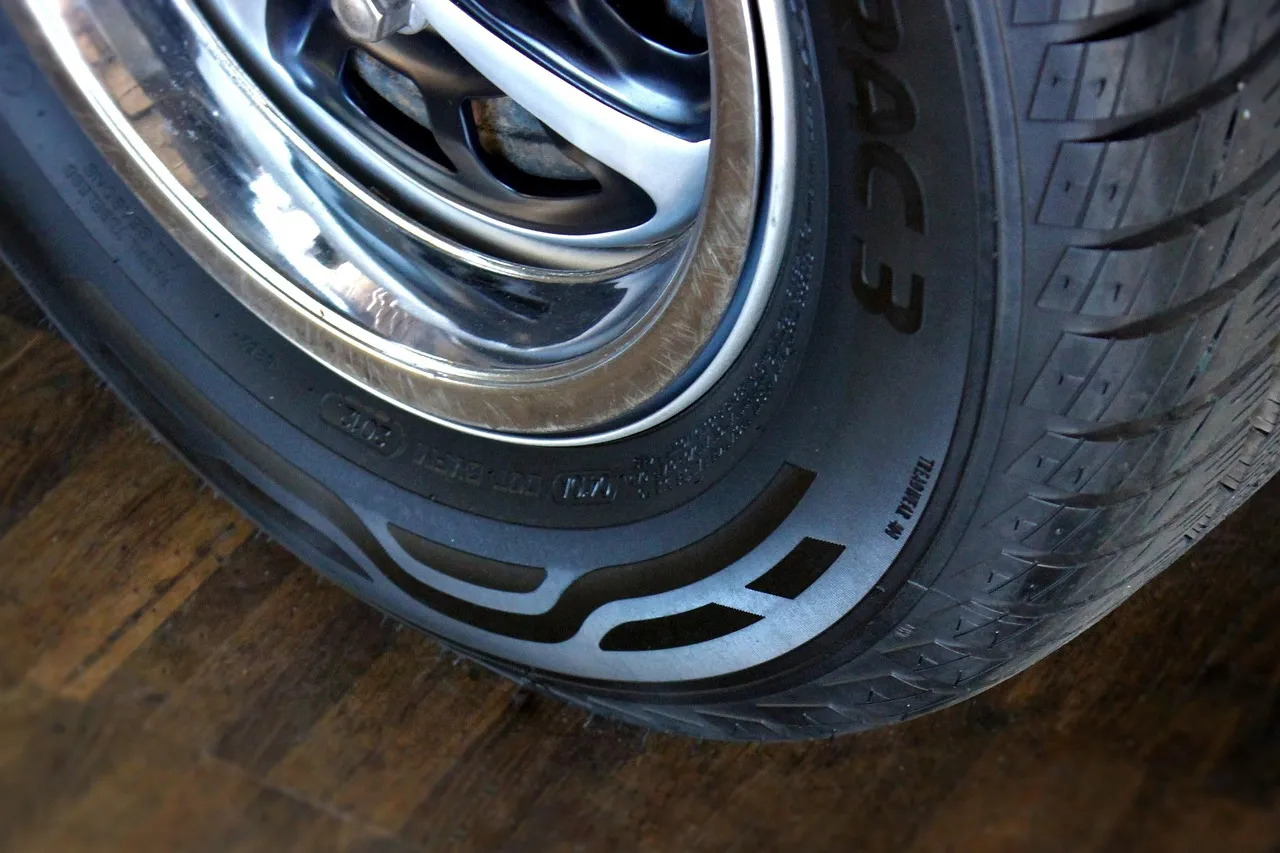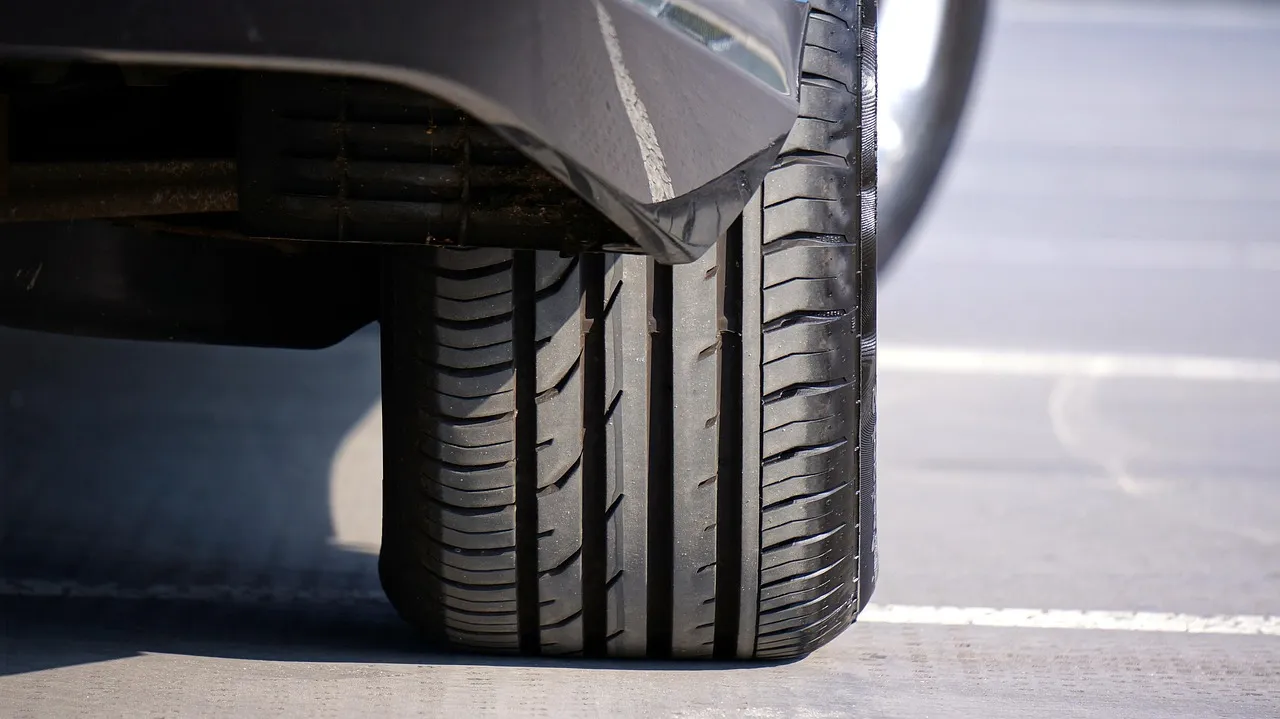
A tyre size such as 205/55 R16 is a code for width, sidewall height and rim, and it works out to one diameter: 631.9 mm. The 2008 text of UN Regulation 30, the approval rule for passenger-car tyres, let a new tyre of that size measure from 625.1 to 640.9 mm, a band of 2.50%. Across 2,990 nominal sizes we swept, as arithmetic, the band ran from 0.75 to 4.52%, with a median of 2.54%. Changing size moves the speedometer by the ratio of the two diameters.
Each sidewall mark is an entry in a published table
Read 205/55 R16 91V from the left. In the 2008 text, 205 was the section width in millimetres and 55 the aspect ratio, sidewall height as a percentage of that width. R marked a radial. The 16 was the rim code, 406.4 mm at 25.4 mm to the inch. American pages spell it tire.
Load index 91 meant 615 kg per tyre, and speed symbol V meant 240 km/h. We did not open the ETRTO or ISO sizing documents. Our 2008 text is the EU Official Journal copy of 30 July, and only UN/ECE originals have legal effect.
The calculated diameter is one point inside a band
The 2008 text set the outer diameter as D = d + 2H, with d the rim diameter and H the width times the ratio. For 205/55 R16, H is 112.75 mm, so D is 406.4 + 225.5 = 631.9 mm. Its limits took 0.97 of 2H at the bottom and, for a radial, 1.04 at the top, so the band was lopsided: −1.07% to +1.43% here.
| Size | Nominal mm | Minimum mm | Maximum mm | Band |
|---|---|---|---|---|
| 205/55 R16 | 631.9 | 625.1 | 640.9 | 2.50% |
| 265/65 R17 | 776.3 | 766.0 | 790.1 | 3.11% |
Our grid ran widths 135 to 355, ratios 25 to 85 and rims 13 to 22, and many of those sizes are not made. In it, 91% had a band over 1.5%. Annex V sizes, which took a tabulated diameter, are excepted.
The band was what the limit permitted on a new, inflated tyre; we measured none, and real ones may sit far tighter. Later supplements exist, one listed as clarifying the snow-tyre maximum, and we could not read them, so nothing here says these limits stand today.
Tread wear is a diameter change of about 2%
A bigger tyre turns more slowly at one true speed, so new reading = old reading ÷ r, where r is the new diameter over the old. The odometer divides by the same r.
Each millimetre of tread lost takes 2 mm off the diameter. Assume, our round figure, 6.4 mm worn evenly away: on 205/55 R16 that is 12.8 mm, or 2.03%. A reading of 100 on the new tyre becomes 102.1 on the worn one. A size change moves it in one step; on nominal diameters:
| From | To | Change | r | 100 becomes |
|---|---|---|---|---|
| 225/45 R17 | 225/40 R18 | +0.46% | 1.0046 | 99.5 |
| 225/45 R17 | 205/55 R16 | −0.38% | 0.9962 | 100.4 |
| 205/55 R16 | 205/60 R16 | +3.24% | 1.0324 | 96.9 |
A low reading is the error the UN speedometer rule forbids
The current text of UN Regulation 39, read in a EUR-Lex copy labelled a documentation tool rather than the authentic text, says "The speed indicated shall not be less than the true speed of the vehicle." Its limit is 0 ≤ (V1 − V2) ≤ 0.1 V2 + 4 km/h, with V1 the speed displayed and V2 the true speed; its conformity-of-production annex gives cars + 6 km/h.
| Displayed km/h | True speed, approval | True speed, production | Largest over-read, approval |
|---|---|---|---|
| 40 | 32.7–40 | 30.9–40 | 22.2% |
| 80 | 69.1–80 | 67.3–80 | 15.8% |
| 120 | 105.5–120 | 103.6–120 | 13.8% |
Our arithmetic, at the test speeds for cars topping 150 km/h. The test runs on "one of the types normally fitted", tyres the maker provides. Cars already on the road were approved under earlier texts.
Regulators' own wording is a text to read in full
Singapore's LTA, on its modifications page (updated 6 August 2026), lists tyres under modifications that do not need its approval, subject to requirements. One is a tyre "of the correct width, profile and diameter recommended by the vehicle manufacturer". Another reads: "The overall rolling radius of the wheels and tyres should remain the same as the original." Rule 14(1) of the construction and use rules, as at 2 November 2026, calls for an instrument showing speed "within a margin of accuracy of plus or minus 10%" above 20 km/h. That rule and Regulation 39 are different instruments, and we did not establish how they interact.
Malaysia's JPJ modification guide, a file created in September 2020, for private vehicles only, says: "Sekiranya rim atau tayar yang lebih besar digunakan, ianya mestilah ditutup sepenuhnya dengan mudguards atau mudflap." "Pemasangan tayar yang lebih besar sehingga mengubah ketinggian keseluruhan kenderaan adalah tidak dibenarkan." In our translation: if a larger rim or tyre is used, it must be fully covered by mudguards or mudflaps; fitting a larger tyre so as to change the vehicle's overall height is not permitted. We did not establish that it is current.
Hong Kong's Transport Department, in its Guide to Notifiable Alteration, a file dated June 2021, says: "Subject to sufficient supporting evidence, tyres of different sizes can be fitted but they must be designed for road use, be compatible with the road wheels, and be adequately load and speed rated for the vehicle in question." It adds that an alteration "must not result in any inaccuracy of the speedometer stipulated in Schedule 16" of Chapter 374A. That schedule, as made by L.N. 151 of 2007, gives private cars registered from 1 May 2008 the same formula as Regulation 39's production limit. We could not read today's consolidated version.
Same-width plus-one sizing is always a near miss
One rim inch adds 25.4 mm for the sidewalls to give back. For the diameter to remain identical, the width multiplied by the drop in aspect ratio would have to equal 1,270. Since 1,270 = 2 × 5 × 127, either the width or the change in ratio would need to be a multiple of 127. No aspect ratio drops that far, and no width in our grid is a multiple of 127, which is why a same-width plus-one is always a near miss on paper.
Across 2,484 starting sizes with ratios of 30 and up, the nearest one on the grid missed by a median of 0.68%. The worst was 2.89%. The grid ignores sales.
Until 2 November 2026 our tyre size calculator printed a true speed, "100.5 km/h actual", and called changes under 1.5% interchangeable. The revision of that date reports the ratio, the 2008 band and the nearest same-width sizes; 205/55 R16 against 205/60 R16, at a reading of 100, returns 96.9.
Your car's own offset is the number no calculator holds
Whether a reading sits above true speed depends on where the speedometer started, and a tyre size does not record that. If a car over-reads by a fraction e, its reading stays at or above true speed only while r ≤ 1 + e. Take e = 2%, a made-up value: on a 633 mm tyre, the margin is gone at 12.7 mm larger. We found no primary figure for the offset carmakers actually build in.

View author profile → · Editorial policy