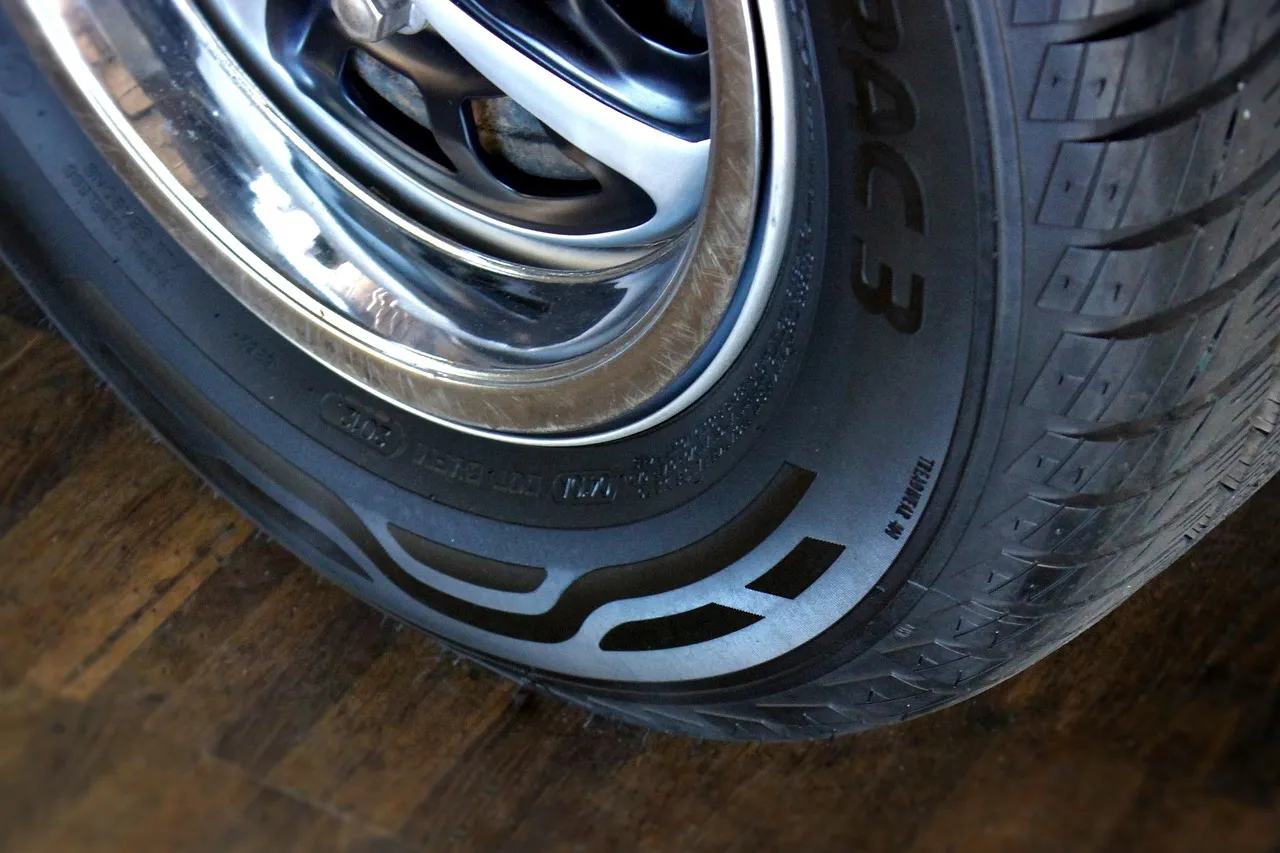
You will find two different tyre-pressure figures on a car: one moulded into the tyre's sidewall, and another on a sticker inside the driver's door frame. The sidewall number is not the one to use. The American regulator states this explicitly: it is not the same as the vehicle manufacturer's recommended pressure.
But this correction is often misinterpreted in a way that makes things more dangerous.
Two documents, and only one of them knows about your car
The sidewall figure applies to the tyre in isolation. The number to use is on the door-pillar placard, because it is specific to the vehicle's weight and how that weight is distributed between the axles.
American federal standard 110 requires that placard, specifies where it goes, and requires it to state the manufacturer's recommended cold inflation pressure for front, rear and spare. A companion provision fixes the relationship between the two numbers: the placard pressure must be at or below the tyre's maximum. And the engineering constraint behind it is that the vehicle's normal load on the tyre may not exceed 94% of the load the tyre is rated to carry at that recommended pressure.
That six per cent margin is the whole reason the placard figure is lower than the sidewall figure. Front and rear differ because, as one tyre maker puts it, weight distribution between the axles is rarely fifty-fifty.
Where the correction goes wrong
Because the sidewall number is higher than the placard number, "do not use the sidewall" gets heard as "that number is dangerously high, stay well under it". That slides into a general bias towards less air.
Every measured harm runs the other way. The American regulator finds that only 19% of drivers inflate correctly, and its crash research attributes elevated risk to under-inflation rather than over-inflation. The failure mode on the road is a slow leak nobody checks, not somebody pumping to the sidewall figure.
The placard number, then, is a minimum to maintain.
What the marking legally means, and the one place it splits
It is tempting to read "max load 615 kg at 350 kPa" as naming the pressure at which maximum load applies, which would be subtly different from a maximum safe pressure. Under American standard 139 those are the same number by definition. Load rating is the maximum load at a given pressure; maximum load rating is the load rating at the maximum permissible inflation pressure; and maximum permissible inflation pressure is the maximum cold pressure to which a tyre may be inflated.
The definitions are self-contained, and the regulator's plain-language gloss agrees that this is the greatest amount of air pressure that should ever be put in the tyre.
Light-truck tyres are the exception, which shows that the concepts are distinct in principle. There the shown pressure must correspond to maximum load, but the manufacturer may print a figure up to 10 psi higher.
Europe does not require the sticker at all
This is the finding that surprised me. Searching the European type-approval regulations for the word "placard" returns nothing operative. It appears only inside a definition, in the United Nations regulations on tyre-pressure monitoring, which describe the recommended cold pressure as what the manufacturer specifies on the vehicle placard and/or in the owner's manual. The binding European requirement is that the information appear in the manual.
The door-jamb sticker on a European car is convention satisfying an "or", not a legal mandate.
The sidewall is different too. The United Nations regulation for passenger car tyres requires a speed category, a load-capacity index and the words "REINFORCED" or "EXTRA LOAD" — and no general inflation-pressure marking at all. The only pressure legend in it is for temporary spares. The commercial-vehicle regulation does require a pressure marking. So the American "max load at X kPa" plate is a national convention rather than something every tyre carries.
For an extra-load tyre, the marking means only that the tyre can accept a higher placard figure if the vehicle requires one; it is not an instruction to inflate it higher. The placard is still the guide.
What under-inflation actually costs
| Effect | Figure |
|---|---|
| Fuel economy | about 0.2% per psi below placard (US energy department); 1% per 2.96 psi in the regulator's own rulemaking |
| Tread life | 1.78% per psi |
| Wet braking | 1 bar low can add 11 metres of wet stopping distance |
| Natural loss | around 0.07 bar a month, roughly 1 psi |
Read the first two rows together, because the ratio between them is the useful part. Ten psi low costs roughly two to three per cent of fuel and about eighteen per cent of tread life. The expensive consequence of a soft tyre is the tyre, not the petrol — which inverts how the advice is usually sold.
The safety mechanism is stated plainly by the tyre industry's own bulletin: under-inflation or overloading causes excessive heat build-up and internal structural damage, which may cause a failure, including tread separation, even at a later date. The damage accumulates and the failure may be deferred, so a tyre that survived a month of being soft has not gotten away with it.
The monitoring systems, and where they are not required
American vehicles have carried tyre-pressure monitoring since September 2007, warning within twenty minutes when a tyre falls 25% below placard. Europe required it for new type approvals from November 2012 and all new cars from November 2014, with a tighter trigger: within ten minutes at a 20% loss or 150 kPa, whichever is higher.
No ASEAN country mandates it. The evidence for that negative is better than an absence of search results: the regulation covering tyre-pressure monitoring is simply not among the nineteen priority regulations in the ASEAN mutual recognition arrangement on type approval, which covers tyre construction only. The single regional signal is a Vietnamese draft circular aimed at construction vehicles over 3.5 tonnes from late 2027.
Singapore's own tyre rule has no number in it. The road traffic rules make it an offence to use a vehicle whose tyre is not so inflated as to make it fit for the use to which the vehicle is being put — a purely qualitative test. The only numeric tyre requirement is tread depth, 1.6 millimetres across at least three quarters of the tread. Japan's inspection standard is identically qualitative: tyre air pressure shall be appropriate.
Two pieces of folk advice, one of which causes the problem it claims to prevent
Letting air out of hot tyres is a mistake that causes the problem it is meant to prevent. The placard figure applies year-round and is a cold specification — cold meaning the vehicle has not been driven for at least three hours. Pressure rising with heat and use is designed in; roughly 1 psi per six degrees Celsius. Bleed a hot tyre down to the placard number and it is under-inflated once cool, which increases sidewall flex, which generates more heat.
The regulator's instruction for a warm tyre runs the opposite way: fill it to the recommended cold pressure anyway, because it is safer to drive slightly under the cold figure than significantly under-inflated.
Nitrogen is a smaller story: true, and almost irrelevant. The industry bulletin says nitrogen inflation is not necessary for normal service, that its properties may contribute to minor reductions in pressure loss, that nitrogen and air may be mixed in any proportion, and — the important sentence — that relying on nitrogen to reduce inflation maintenance may lead to under-inflated operation. One maker calls it a frivolous waste of money for everyday use, conceding only that pressure holds marginally better over the long term. Compared to a natural loss of about 1 psi a month, plus any valve or bead leaks, the benefit from nitrogen is trivial next to what a monthly pressure check accomplishes.
The check that is worth doing
Find the placard, not the sidewall, and check when the tyres are cold. If a reading is low, fill to the placard figure rather than splitting the difference with what the gauge says warm. The real incentive is tread life. At nearly two per cent of wear per psi of under-inflation, a pressure check pays for itself in rubber long before it does in fuel.
Where these figures were read
The placard requirement, its position on the vehicle and the 94% load constraint are from United States federal motor vehicle safety standard 110; the marking definitions and the light-truck exception from standard 139; the monitoring requirement and its threshold from standard 138. All were read through the electronic code of federal regulations' own interface, because its web pages refuse automated requests. The fuel, tread-life and crash figures are from the regulator's 2005 monitoring rulemaking and its consumer tyre pages, with the per-psi fuel figure from the energy department's fuel economy site. The heat and failure mechanism is quoted from the United States Tire Manufacturers Association's information bulletin of June 2024, and the nitrogen material from the same bulletin and a tyre maker's technical page. The European position is from the type-approval regulations and United Nations regulations 30, 54, 64 and 141, read through the European legislation portal. Singapore's rule is road traffic construction and use rule 109, read on Singapore Statutes Online. All were read on 18 September 2026.
Three things are deliberately absent. The load and inflation tables published by the international tyre standards bodies are commercial publications and could not be obtained, so no figure is quoted from them. A pair of reference pressures widely attributed to the United Nations passenger-tyre regulation — 250 and 290 kPa — is not in its text, which uses speed-dependent test pressures instead; the figures appear to belong to a trade association's manual and are left out rather than misattributed. And no Malaysian crash statistic appears here: the national road safety institute's own report on the subject is a dead link on its own server.

View author profile → · Editorial policy