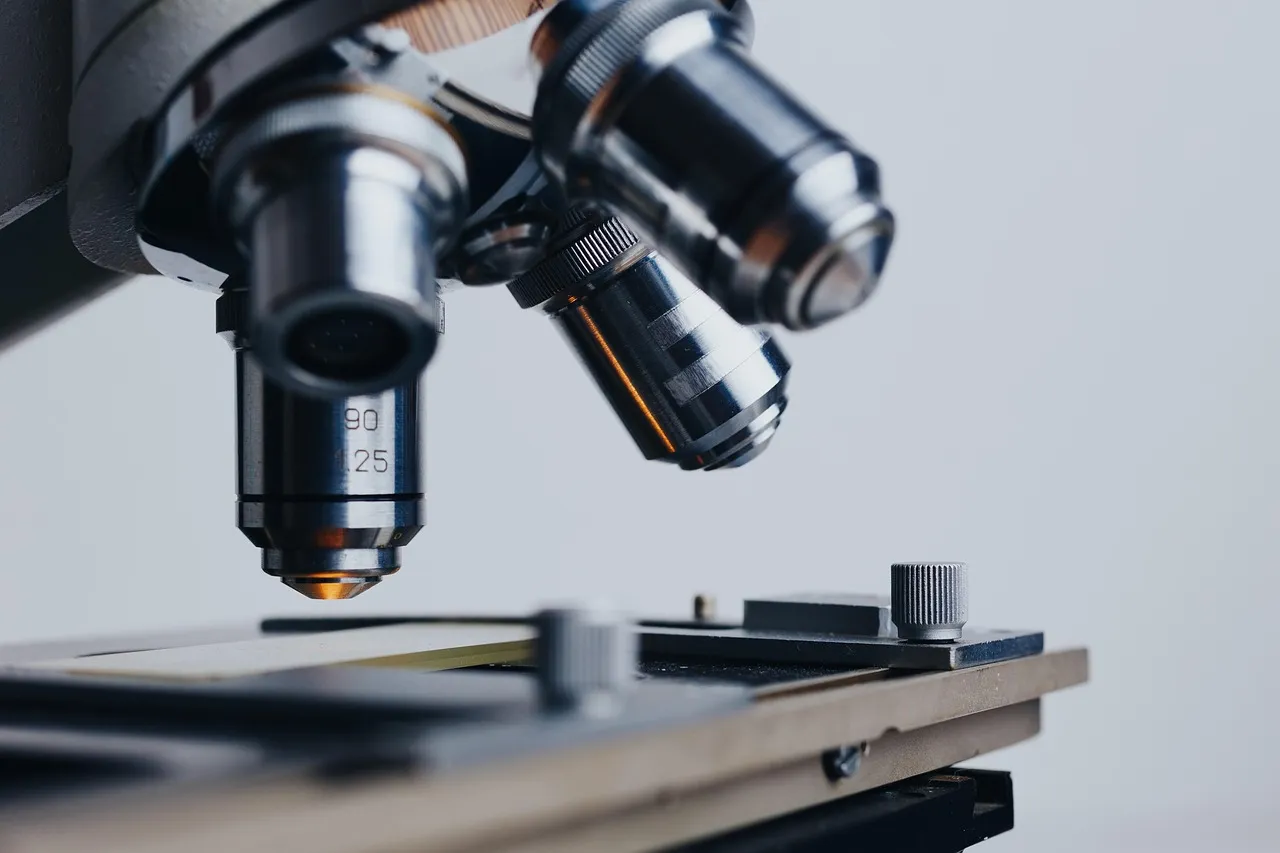
A compound microscope's power is a multiplication: total magnification = objective × eyepiece, so a ×40 objective with a ×10 eyepiece gives ×400. That figure says nothing about detail. We ran three ways of reaching ×400 through the formula as Ernst Abbe printed it in 1882, in green light at 550 nm with his factor of 0.5. They put very different limits on the detail the objective can pass: 688, 423 and 212 nanometres. The finest of those needs more magnification before an eye can use it. The usual useful range, 500 to 1000 times numerical aperture, matches Abbe's published working, which rests on viewing angles he set for an average eye.
A total of ×400 needs an aperture figure to mean anything
Numerical aperture, or NA, describes how wide a cone of light an objective gathers; Nikon's MicroscopyU, a manufacturer's education site, gives it as n × sin(µ). Abbe's limit, on p. 461 of his 1882 paper in the Journal of the Royal Microscopical Society, is δ = ½ · λ/a, with a the aperture and λ the wavelength, for which 0·55 μ gave him "a fair average". Our three pairs use Nikon's typical apertures.
| Objective, eyepiece | δ | 500–1000 × NA | Where ×400 sits |
|---|---|---|---|
| 20×/0.40 plan achromat, 20× | 688 nm | ×200–400 | at the ceiling |
| 40×/0.65 plan achromat, 10× | 423 nm | ×325–650 | inside |
| 40×/1.30 oil plan fluorite, 10× | 212 nm | ×650–1300 | below the floor |
δ is what the objective can pass, assuming a condenser matched to it. What a viewer sees at ×400 is another matter. With the 0.61 factor on Nikon's resolution page the three limits become 839, 516 and 258 nm. Abbe held his expression strictly for periodic structures and as an "approximate" measure for the rest.
Abbe's working requires a viewing angle judged for an average eye
Abbe started from the diatom Pleurosigma angulatum, whose lines lie about 0·5 μ apart. On p. 462 he assigns 300 and 600 diameters as its useful limits, the upper one for an aperture up to 0·6, leaving "latitude for personal diversities". From that example, "in accordance with many similar facts", he asks that the smallest detail appear under "not less than 2' and not more than 4', approximately", for distinct and convenient observation by an average eye. Four minutes, he adds on p. 465, is about an eighth of the moon's apparent diameter.
At 250 mm and 0·55 μ he gets N = 264·5 a v (p. 463), so an aperture of 1·00 prints as 529 at 2' and 1058 at 4'. Nikon's useful range page says the floor is "usually rather arbitrarily set" at 500 × NA, deriving it from the same 250 mm, 550 nm and 2'. No source we opened says the modern rule descends from Abbe's table, so "matches" is as far as we go.
His theory could not "establish an absolute rule", he wrote on p. 469, only "a proper basis for finding a rational balance".
Fine detail calls for more magnification before an eye can use it
At ×400 and 250 mm our three limits subtend 3.8, 2.3 and 1.2 minutes of arc, by our arithmetic, and only the first two fall inside Abbe's band. The 212 nm limit, about 0.2 µm, is under half the diatom's line spacing. At too low a power such structure, he wrote, "would remain hidden from the eye". A classroom set, at Nikon's plan achromat apertures:
| Objective | Useful total | With 10× | Past the ceiling from |
|---|---|---|---|
| 4×/0.10 | ×50–100 | ×40, below | above 25× |
| 10×/0.25 | ×125–250 | ×100, below | above 25× |
| 20×/0.40 | ×200–400 | ×200, at the floor | above 20× |
| 40×/0.65 | ×325–650 | ×400, inside | above 16.25× |
| 100×/1.25 oil | ×625–1250 | ×1000, inside | above 12.5× |
The two lowest rows are no fault. Nikon writes that very low magnifications, "1x through 4x", are often used to map a wide field. Abbe covers the 10× row as well: "a surplus of aperture is no drawback by itself" (p. 469).
Wider apertures at the same power need more eyepiece to reach the floor
The floor scales with NA and the eyepiece list stays put, so this is a consequence of the arithmetic. We paired 22 of the 26 objectives in Nikon's aperture table, leaving out the 0.5×, 1×, 150× and 2× achromat, with the five eyepieces on its useful range page, 10× to 25×. Of the 110 pairs, 29 fell below the floor. Plan achromats fell short in 2 of 30 and plan apochromats in 18 of 45. Adding a 5× and a 16×, our own unsourced additions, gives 57 below of 154. These are possible pairs and imply nothing about use.
Until 1 November 2026 our microscope magnification calculator rounded by significant figures, so 4 × 16 printed ×60 and the eyepiece echoed as ×20. It now prints exact products, takes an optional aperture and solves image size ÷ actual size. Enter 40/0.65 with 16 for ×640, finest detail about 423 nm and a range of ×325 to ×650, labelled within; 20 gives ×800, labelled above.
Empty amplification in Abbe's text requires power much beyond his table
Abbe's sentence, across pp. 464–465, reads: "we shall have an empty amplification, which does not improve the representation of the objects, if the power should go much beyond the maximum figure." His first worked case, on p. 466, is the diatom at aperture 0·6 under 1000 diameters, where details "are mere optical illusions". That is about 1667 × NA, two-thirds above the round ceiling. Modern pages draw the line sooner: Leica calls any value beyond the useful range empty. Of our 154 pairs, 30 pass 1000 × NA and 5 pass Abbe's example.
He pulled both ways. Higher figures can be "very useful or even necessary; as, for instance, for counting, measuring, drawing, &c.", yet for research they "are not required and are not even advantageous" (p. 465). Excess power "is, or at least may be, a positive obstacle to correct recognition" (p. 466), and still "a reasonable latitude for further increase of power" must be left (p. 472). In green light the useful ceiling tops out near ×1,500: his table prints 1534 at his oil limit of 1·45.
Cambridge's biology syllabus asks for image size over actual size
The syllabus for Cambridge IGCSE Biology 0610 states something other than objective × eyepiece. Section 2.2 of its 2026–2028 syllabus, like the 2023–2025 one, says "magnification = image size ÷ actual size", and the practical skills list asks for line drawings, "calculating the magnification or actual size". The word microscope appears in neither PDF's text, which is all we claim. So a 90 µm cell, a made-up example, drawn 45 mm long has a magnification of 45 ÷ 0.09 = ×500, whatever the instrument was set to.
The engraved 40× assumes a particular tube
For an infinity-corrected objective, Nikon's page says magnification comes from "dividing the reference focal length (tube length) by the focal length of the objective", and lists tube lengths of 165, 180 and 200 mm. A 5 mm objective is therefore 40× on a 200 mm tube, 36.0 on 180 mm and 33.0 on 165 mm. That is arithmetic only, with no claim about performance. The engraved power holds for the tube length the objective was designed around.

View author profile → · Editorial policy