The large pack is usually cheaper per unit. That is the rule everyone shops by, and it is right often enough that nobody checks — which is precisely what makes the exceptions profitable.
Checking is one division: price divided by quantity. The difficulty is never the arithmetic. It is that the two things you are comparing have been made deliberately hard to divide.
Three ways a shelf stops you dividing
The units differ. One product is 750 g, the next is 1.2 kg, the third is 24 oz. These are all masses and all convertible, so this is the easy case — but it still stops most people, because doing it in your head while holding a basket is not realistic.
The multi-buy hides the count. A "3 × 200 ml" pack and a single 600 ml bottle contain the same volume at different prices, and the shelf label frequently prices one per pack and the other per litre.
One is sold by weight and the other by volume. This case cannot be solved by conversion at all, which makes it the one worth understanding.
Why grams and millilitres do not convert
A 500 g jar and a 500 ml bottle are not the same quantity of anything, and no amount of unit conversion will make them comparable. Going from one to the other needs the product's density, which the label does not print.
The usual instinct is to assume water — one millilitre, one gram. Here is what that assumption costs.
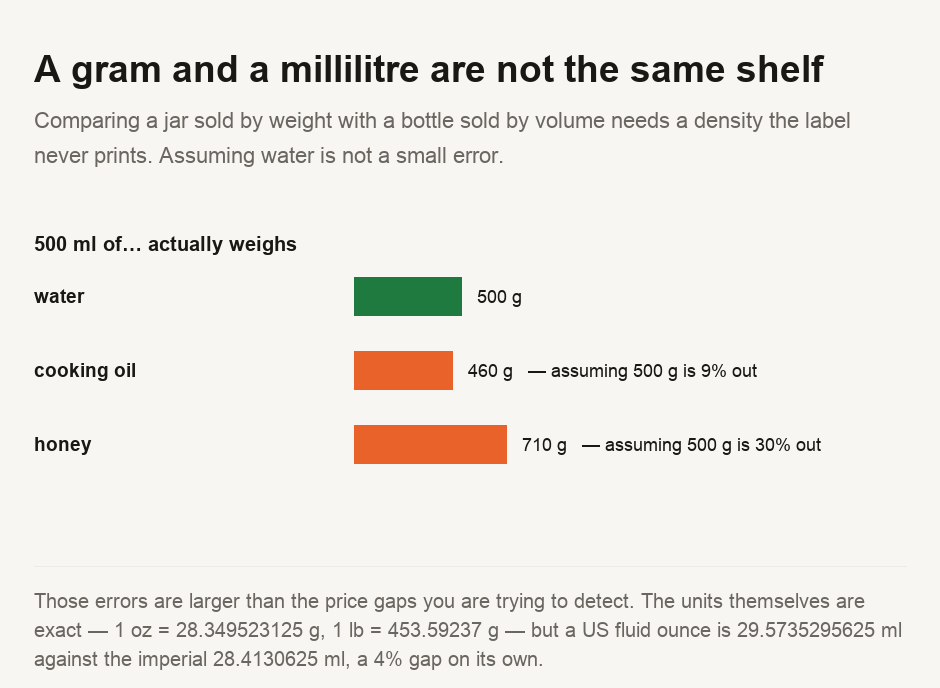
Half a litre of cooking oil weighs about 460 g, not 500. Half a litre of honey weighs about 710 g. Treat that honey as 500 g and you understate its mass by roughly 30 per cent. Run the comparison the other way — assume a 500 g jar is 500 ml when it is really about 352 ml — and you overstate the volume by 42 per cent.
Either way the error dwarfs what you were looking for. Nobody switches brands over 3 per cent. A 30 to 42 per cent error will comfortably invert the answer.
So the rule is not "convert carefully". It is that mass and volume are different questions, and a comparison across them is not available without information the shelf does not give you. Our unit price comparator refuses that comparison rather than guessing a density, which is the only defensible behaviour: a confident wrong answer here is worse than no answer.
The conversions that do work, and one trap inside them
Within mass, and within volume, the conversions are exact and worth knowing: 1 oz is 28.349523125 g and 1 lb is 453.59237 g.
Volume carries a trap. A US fluid ounce is 29.5735295625 ml. An imperial fluid ounce is 28.4130625 ml. That is a 4 per cent difference between two units with the same name, on shelves in a region that imports from both systems — comfortably enough to reverse a close comparison on its own, before any density question arises.
What we are not claiming
We built this tool because our guides programme kept hitting the same snag: comparisons that need one simple division nobody ever performs. It was not because we measured search demand for this query and found a gap. A price comparison is not novel, and plenty of shelf labels now print a unit price.
What they do not do is handle the multi-buy count for you, or flag an invalid comparison. That is why this tool exists.
Divide price by quantity, using whatever unit both products already share; that single division catches almost everything, including the large pack that is quietly worse. Multiply out multi-buys first, comparing a 3 × 200 ml pack and a 600 ml bottle as 600 against 600. If one product is sold by weight and the other by volume, stop. That comparison needs a density the label does not print, and assuming water is 9 per cent wrong for oil and about 30 per cent wrong for honey — an error bigger than any saving you were hunting. Finally, watch fluid ounces: the US and imperial versions differ by 4 per cent under the same name.
Doing it at the shelf
Our unit price comparator handles several products at once, normalising their units and pack counts to show the premium each carries over the cheapest, while correctly refusing to convert mass into volume. If you only need a one-off conversion, the unit converter does that. To turn a premium into what it costs you over a year rather than per jar, use the percentage calculator.
- The unit conversions are the international avoirdupois and US/imperial definitions, pinned in our home kernel and asserted by its test suite: 1 oz = 28.349523125 g, 1 lb = 453.59237 g, 1 US fl oz = 29.5735295625 ml, 1 imperial fl oz = 28.4130625 ml. They were recomputed independently for this guide rather than read back from the tool.
- ⚠️ The densities are illustrative, not measured by us: water 1.0, cooking oil about 0.92, honey about 1.42 g/ml. Real products vary with temperature, composition and brand. They are used here to show the SIZE of the error a water assumption introduces, and that conclusion does not depend on the third decimal place.
- ⚠️ The two density errors are stated in both directions on purpose, because they are different numbers for the same mistake: treating 500 ml of honey as 500 g understates mass by about 30 per cent, while treating a 500 g jar as 500 ml overstates volume by more than 40 per cent. Quoting one figure without saying which comparison it belongs to is how this gets misreported.
- ⚠️ We did not measure search demand for this specific question. The tool was built from a pattern the guides programme kept hitting, and this page says so rather than implying a gap we did not verify.
Prices, pack sizes and shelf labelling rules differ by country and retailer. The arithmetic here is general; whether a particular label already gives you a comparable unit price is something only the shelf in front of you can answer.

View author profile → · Editorial policy