4 SEP 2026 — NASA's Nancy Grace Roman Space Telescope is a survey instrument. It launched from Kennedy Space Center on 30 August aboard a Falcon Heavy and is a month into its trip to the second Lagrange point. It carries the same 2.4-metre mirror as Hubble, and about a hundred times the field of view. First images are not expected until early 2027.
Where it is and what happens next
Lift-off was at 7:26am Eastern on 30 August. The rocket released the telescope about thirty minutes later on a trajectory to L2, roughly 1.5 million kilometres from Earth, a trip of about thirty days.
Commissioning then runs for three months, during which the instruments are calibrated and tested. NASA expects to release the first images in early 2027, which is around five months after launch.
L2 is where Webb operates. It is a gravitationally convenient point that keeps the Sun, Earth and Moon in the same direction, so a sunshield can block all three at once and the instruments can stay cold.
Wider, not sharper
The instinct with a new space telescope is to expect a better version of the last one, and that is the wrong model here. Roman's mirror is the same diameter as Hubble's, so its resolution and its light-gathering power are comparable rather than superior.
What differs is the 300-megapixel Wide Field Instrument, which covers about a hundred times more sky per exposure. A region Hubble would need a hundred separate pointings to cover, Roman captures in one.
That is a survey instrument rather than a zoom lens. It does not see fainter or finer than Hubble; it sees the same depth across an enormously larger area, and the science it enables is statistical rather than individual.
The consequence is measured in observing time, which is the real currency of astronomy. Every large survey competes for years of a telescope's schedule, and a hundredfold field means a programme that would have consumed a decade of Hubble time fits into weeks. That is what changes which questions are askable rather than merely which are answerable.
Why area is the scarce resource for dark energy
Roman's headline objective is dark energy, and the reason a wide field matters is that the measurement is a counting exercise. The expansion history of the universe is inferred from how the distribution of galaxies and the distortion of their shapes by intervening mass change with distance.
Both of those are noisy per object and precise in aggregate. Getting a useful constraint means measuring hundreds of millions of galaxies, and no amount of resolution substitutes for having enough of them.
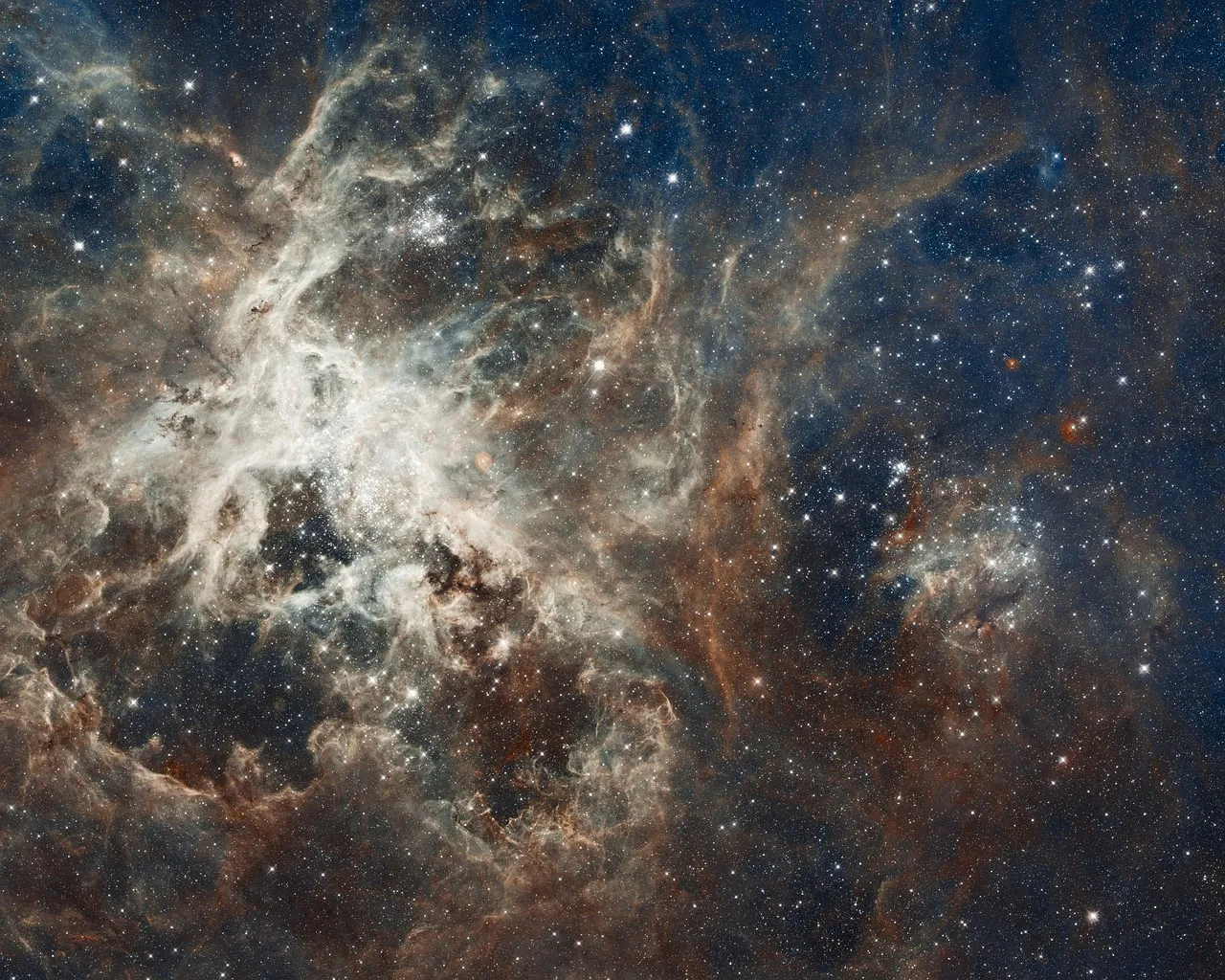
The actual output to expect is a catalogue. The images that get published will be spectacular, because a wide field of a rich sky always is, and the result the mission was built to produce is a table of positions, shapes and redshifts that other people will analyse for a decade.
That also determines who benefits. A survey catalogue is a public dataset, so the science does not stay with the team that built the instrument: any group with the statistical skill and the compute can work it, including groups at institutions that would never win time on a flagship telescope.
It does not replace Webb and it is not competing with it
Both operate at L2 and both work in the infrared, which is where the comparison usually stops. Webb has a 6.5-metre segmented mirror and is built to look at small numbers of very faint objects in great detail, including spectroscopy of individual exoplanet atmospheres.
Roman cannot do that and is not meant to. The complementarity is that Roman finds candidates across an enormous area and Webb examines the interesting ones, which is a division of labour rather than a duplication.
The same holds for exoplanets. Roman's method is microlensing, which detects a planet by the brief brightening as its star passes in front of a more distant one, and that requires monitoring millions of stars continuously. It is a technique that only works with a wide field, and it is sensitive to planets on wide orbits that transit surveys systematically miss.
What five months of nothing means
A gap between launch and first images invites a particular kind of coverage, and it is worth being clear that the gap is normal. Cooling to operating temperature, aligning optics, characterising detector noise and confirming pointing accuracy all take time, and rushing any of them produces a decade of degraded data.
Webb's first images came about six months after launch, on a comparable schedule. The difference is that Webb's deployment was mechanically dramatic, with a sunshield and mirror segments to unfold, and Roman's is not.
So the milestone worth watching is not a picture. It is confirmation that the Wide Field Instrument's focal plane performs to specification across its full area, because a survey telescope whose corners are soft loses precisely the advantage it was built for.
Everything before that is a spacecraft in transit doing what spacecraft in transit do. The interesting failure modes for this mission are optical and statistical, and neither becomes visible until the instrument is cold, aligned and pointed at something worth counting.

View author profile → · Editorial policy