
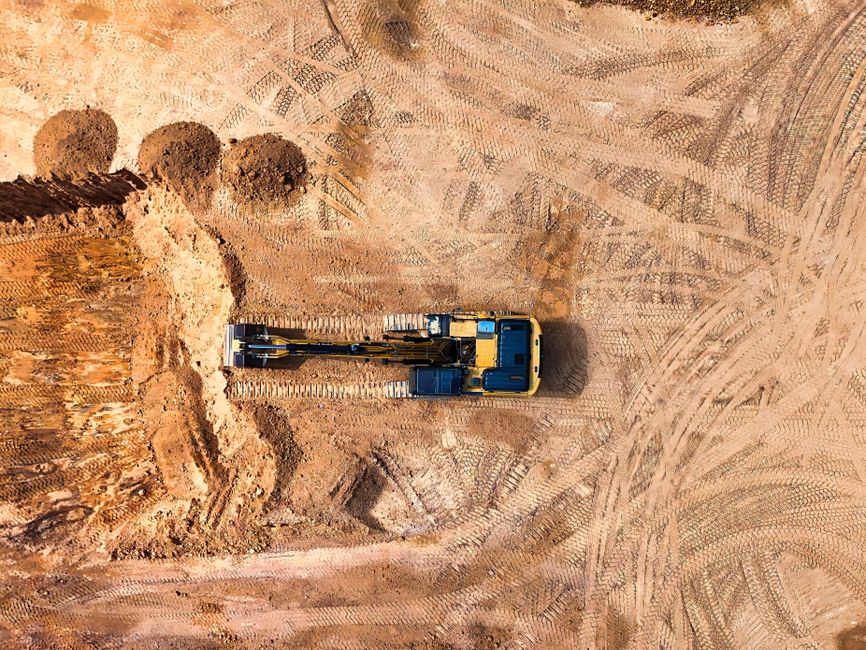
19 SEP 2026 — An excavator at a yard in Jurong is digging with nobody in the cab. A compactor is following behind it, also unmanned. JTC, Singapore's industrial landlord, wants one operator supervising two machines instead of driving one.
The target is a 50 per cent cut in the skilled operators a site needs. The reason given is not cost.
What is running at Bulim
The pilot is at the Bulim Autonomous Yard in the Jurong Innovation District, run by JTC Corporation and the Japanese contractor Kajima. AsiaOne reported the joint announcement on 17 September.
Two machine types are in the trial. The excavator runs automation software from Gravis Robotics, a Zurich start-up working on autonomous earth-moving equipment. The compactor presses material down to stabilise ground and runs on A4CSEL, Kajima's own automated construction system.
The Public Sector Science & Technology Policy & Plans Office and the Housing & Development Board are both in the partnership, alongside Kok Tong Construction and Tractors Singapore. Bulldozers and dump trucks are intended to join next year, making a coordinated sequence: an excavator digs, a truck carries, a bulldozer spreads, a compactor stabilises.
The number that explains it
JTC says it has a pipeline of at least 800 hectares of earthworks over the next five years. That figure is the demand side of a labour problem.
Calvin Chung, JTC's assistant chief executive officer for engineering and operations, put the constraint plainly: "Adding more manpower is not a sustainable way to meet Singapore's future construction needs."
Read that as a statement about supply. Singapore builds with a construction workforce it largely imports, under quotas and levies it sets deliberately. The sentence concedes that simply hiring more people is a lever the country does not intend to pull.
Who is watching, and from where
The two accounts differ. TechNode Global reported that the machines work independently with no operator in the cabin or elsewhere, using sensors and AI, while staff monitor remotely and step in when something goes wrong. AsiaOne describes the same remote monitoring and intervention but does not state whether anyone remains in a cab.
The distinction matters. A machine with nobody aboard that a remote supervisor can halt is a different safety argument from a machine with a person in the seat who is not steering. The two arrangements fail in different ways.
A closed yard is not a public road
This is a controlled site, which is both the point of a dedicated autonomous yard and the limit of what the pilot demonstrates. Nobody is walking a dog past the excavator.
The contrast with the other autonomy story in this country is instructive. We reported this week that Singapore welcomed Waymo while pacing how fast it can deploy, tying permission to how quickly drivers can be retrained. Construction plant faces no equivalent public-facing test, because the hazard it manages is to the workforce around it rather than to passengers or pedestrians.
That makes the yard the easy part. Earthworks on a live site, with subcontractors, deliveries and other trades moving through, is the condition the technology has to survive. It is not what has been demonstrated.
What is not disclosed
No end date for the trial, no cost, no figure for what the machines have moved, and no safety statistics. The 50 per cent target is an objective rather than a result, and no baseline has been published against which to measure it later.
The expansion to bulldozers and dump trucks next year is an intention. Yoshihiko Riho, a Kajima senior executive officer, framed it as continuing development with JTC and local partners rather than as a committed rollout.
Watch whether any of this leaves Bulim. A pilot at a purpose-built autonomous yard proves the machines work; a pilot on a live HDB earthworks site would prove something considerably harder.