
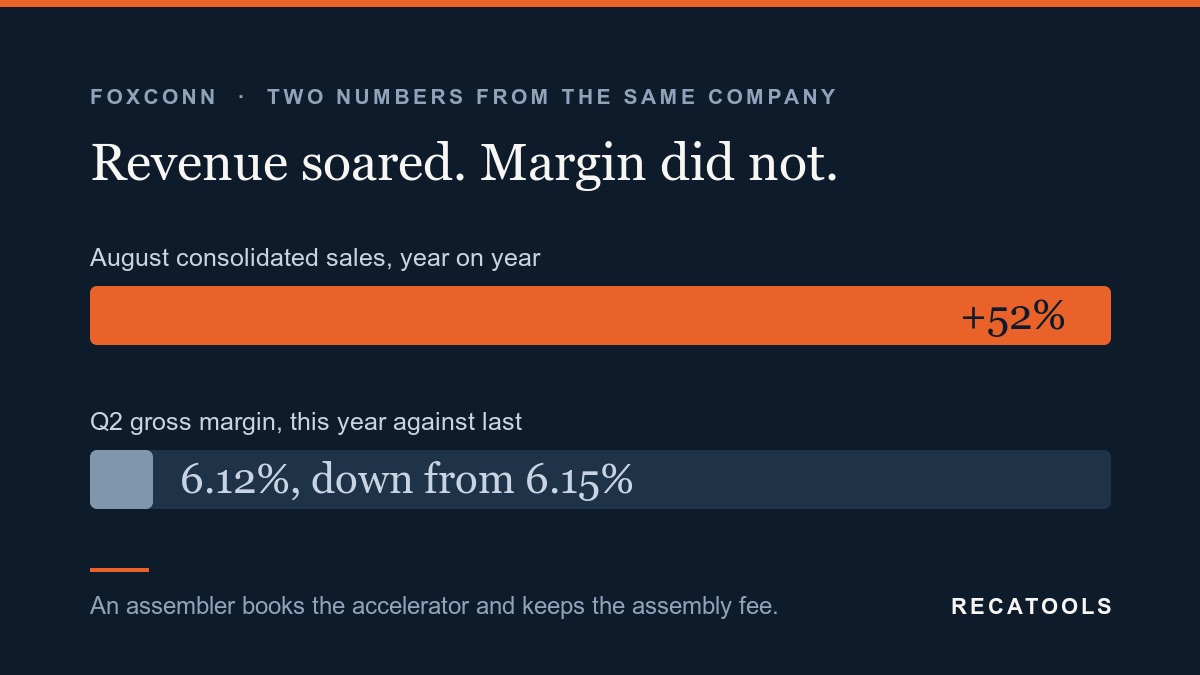
7 SEP 2026 — Hon Hai Precision, better known as Foxconn, reported August consolidated sales of T$921.8 billion, about US$29.15 billion, up 52 per cent year on year and a record for the month. Revenue is the wrong number to read an assembler by. Gross margin in the second quarter was 6.12 per cent, slightly lower than a year earlier, while AI servers passed half of sales for the first time.
The figures, in the order they matter
August was the second consecutive month above T$900 billion. Nvidia's largest server assembly partner is running at a pace that would have been implausible two years ago, and management has said third-quarter results will beat expectations as AI demand grows and consumer electronics enter their peak season.
In the second quarter, AI servers crossed 50 per cent of total revenue for the first time, overtaking iPhone assembly. That is a structural change in what the company is.
Over the same period gross margin was 6.12 per cent, against 6.15 per cent a year earlier. Earlier in the year it ran at 5.88 per cent. The mix shifted decisively toward AI and the margin did not move up with it.
Why revenue flatters an assembler
A contract manufacturer books the full value of what it ships. An AI server rack containing Nvidia accelerators is an expensive object, and every dollar of that accelerator passes through Foxconn's revenue line on its way to Nvidia.
The company keeps the assembly fee. That is why a 52 per cent revenue increase can sit alongside a gross margin in the low sixes, and why profit growth of about 19 per cent trailed revenue growth of about 29 per cent in the same period.
The mechanism is not new. It applied to iPhones for fifteen years. But the leverage is larger now, because the bill of materials in an AI rack is far more expensive than in a phone. Higher-value content flowing through the same thin margin produces spectacular revenue and modest earnings.
The comparison is the wrong way round
The narrative is that by swapping iPhones for AI servers, Foxconn is escaping one low-margin business for a better one. The reported numbers do not support it.
Server assembly carries slightly better margins than smartphone assembly. Both are single-digit businesses where only volume pays. Swapping one for the other changes the customer concentration and the cyclicality, and it does not change the economics of being the party that screws the components together.
What it does change is who Foxconn depends on. iPhone assembly was one customer with a predictable annual cycle. AI server assembly is a smaller set of customers on a cycle nobody has seen through a downturn, and the demand behind it is capital expenditure rather than consumer purchases — which is to say it is a decision a handful of finance committees can revise.
Why there is a monthly number at all
Taiwan requires its listed companies to publish consolidated revenue every month, within ten days of the month closing. Almost no other major market does, which is why Taiwanese supply-chain releases have become the highest-frequency public indicator of the AI build-out anywhere in the world.
This is useful. When the question is whether racks are still shipping, a monthly figure from the world's largest assembler answers it faster than any quarterly result or analyst channel check.
The catch is built into the same rule. A monthly release is unaudited, carries no margin, no profit and no segment split, and exists to give the market a timely top line rather than a picture of the business. Reading it as a health check on the company asks it to do a job the disclosure was never designed for.
The constraint the chief executive named
Foxconn's chief executive has pointed at advanced packaging, and specifically CoWoS capacity, as the ceiling on AI server output into 2027. That is a useful thing to hear from an assembler, because it says the limit is upstream of them.
An assembler cannot ship racks faster than accelerators arrive, and accelerators cannot be produced faster than they can be packaged. Reading Foxconn's monthly revenue as a demand signal therefore has it backwards. It is closer to a throughput signal for somebody else's packaging lines.
We have seen the same substitution in other links of this chain. Broadcom's 221 per cent AI revenue growth arriving with a guidance miss, and SMIC's record revenue coming from price rises on scarce mature nodes rather than from volume. In each case the headline number described something other than what it was taken to describe.
What would actually be evidence
Evidence would be one of three things, none of them a monthly sales release. Gross margin trending up as the AI share of revenue rises, which would mean the mix shift is finally earning something. Operating profit growth matching or beating revenue growth over a full year rather than a quarter.
And any sign of Foxconn capturing value above assembly — its own liquid cooling, power distribution or rack integration sold as its own product rather than as pass-through content. The company has moved in that direction; the margin line is where it will show up if it works.
Until one of those turns, a record month is a record month. It says the AI build-out is still running at volume, which is worth knowing, and it says almost nothing about whether the company assembling it is making more money per unit than it was a year ago.