Every electrical code carries a limit on how much voltage a cable run may lose. Three per cent is the usual figure, and it is filed under performance: keep the volts up so the motor starts and the lights do not dim.
It is also, silently, an efficiency limit — and the number is exactly the same.
Where the missing volts go
The volts a run loses do not disappear. The current pushes through the conductor's resistance, and the difference is dissipated as heat along the whole length of the cable, inside the walls.
How much heat is the current times the voltage lost. The power delivered is the current times the full voltage. Divide one by the other and the current cancels: the share of power burned in the cable is the percentage voltage drop.
A run at the three per cent limit is therefore converting three per cent of the power it carries into warm plaster.
That identity is not an approximation, and we did not take it on trust. Checked across every conductor size the engine knows, at four currents and three lengths — 216 combinations — the largest disagreement between the two percentages was 0.0000000000000036, which is the arithmetic of floating point rather than of electricity.
What three per cent costs in watts
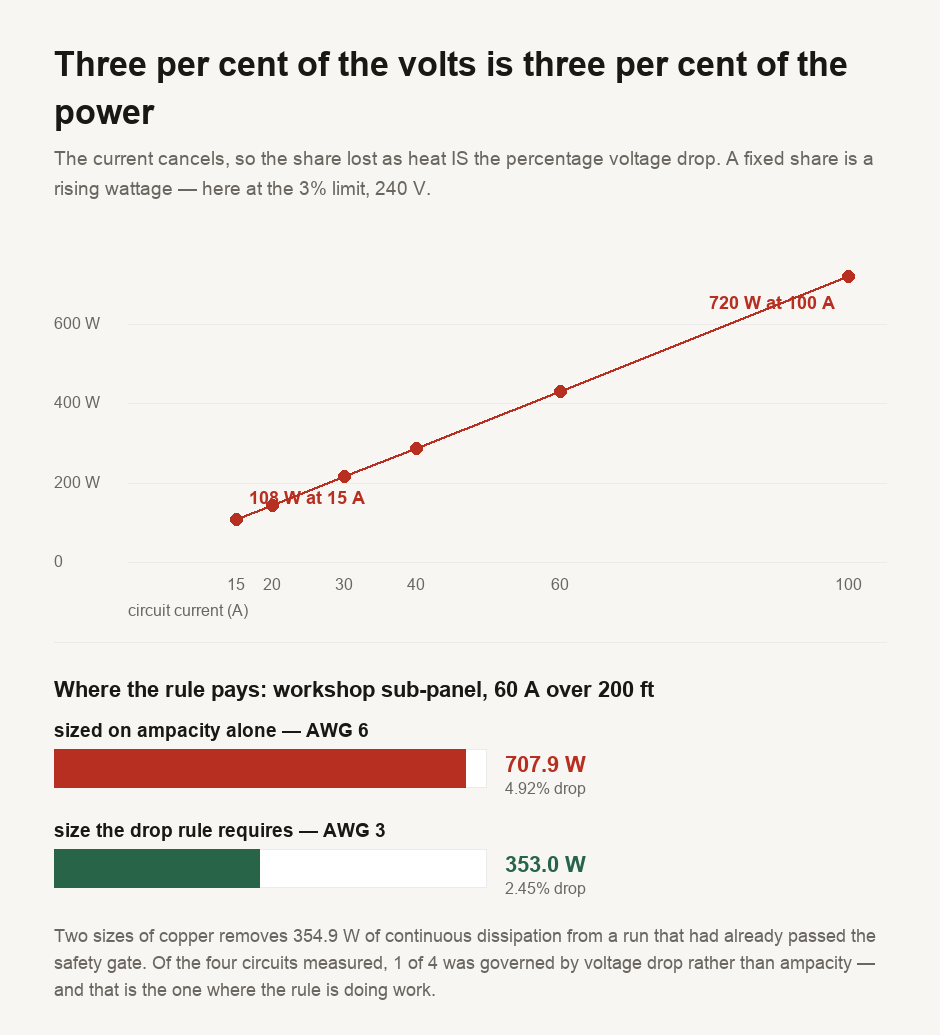
Because the share is fixed, the wattage rises with the circuit. On a 240-volt supply, a compliant run sitting exactly at the limit burns 108 watts on a 15-amp circuit and 720 watts on a 100-amp one.
A compliant 100-amp circuit at the limit can be dissipating that much — a small heater — indefinitely inside the walls. This is the behaviour of a circuit that is fully compliant.
The rule that quietly pays for itself
The wattage lost is more than a footnote. Sizing a cable has two separate gates: the conductor must be thick enough to carry the current safely, and the run must not lose too many volts. Which one binds depends on the length.
Of the four circuits we ran, three were settled by ampacity — the drop rule asked for nothing extra. The fourth was a workshop sub-panel drawing 60 amps over 200 feet, and there the two gates disagreed.
Ampacity alone permits AWG 6. At the circuit's current that run loses 4.92 per cent, which is 707.9 watts of continuous heat.
The voltage-drop rule pushes it two sizes up to AWG 3. The same load then loses 2.45 per cent, or 353.0 watts.
The rule cut 354.9 watts of waste from an already-safe circuit. What looks like a performance requirement for thicker, costlier copper is in fact the code saving you the price of running a space heater.
Why this is not an argument for thinner cable
None of this is an argument for using thinner cable. A run at four or five per cent is not necessarily dangerous, just as the safe minimum is not always the right answer.
Ampacity is about the conductor's own temperature and it is a safety limit. Voltage drop is about what arrives at the other end. They are different questions with different answers. Clearing the safety check says nothing about performance, which is why the sub-panel circuit passed one and failed the other.
The arithmetic gives the voltage-drop percentage a third meaning: it is the fraction of energy that never arrives.
What we did not measure
The original question was why a phone charger gets warm, and we could not answer it honestly. Our engine's conductor table starts at AWG 14 and runs up to 500 kcmil, which is building wiring. A USB lead is AWG 20 to 28 and is not in it.
A charger's warmth is also probably not from the cable. Most of that warmth is its converter, changing mains AC into low-voltage DC. Publishing a cable figure for it would have been a number about the wrong component, computed from a table that does not contain it.
Reading a drop figure
A voltage-drop percentage is thus a direct measure of two things: the voltage available to the load, and the fraction of your power bill spent heating the wall.
On short domestic runs both readings are small and the question does not arise. It starts mattering on long runs, high currents and continuous loads, such as a sub-panel to an outbuilding, a pump or a condenser, where the same percentage is attached to a much larger number of watts.
If the voltage-drop rule forces a thicker conductor than ampacity requires, the code is not being fussy. It is telling you the cheaper wire would have wasted the price difference on heat.
A cable's percentage voltage drop is also its percentage power loss. We verified that identity across 216 size, current and length combinations, to within floating-point noise, which makes the familiar three per cent performance limit a three per cent efficiency cap as well. A compliant 100-amp circuit at that limit is dissipating 720 watts into the structure. The rule matters most where it, and not ampacity, decides the size: for a 60-amp run over 200 feet it forced a jump from AWG 6, losing 707.9 watts, to AWG 3, losing 353.0 — cutting 354.9 watts of waste from a circuit that was already safe. None of which makes a thinner run dangerous. Ampacity is the arbiter of safety, which is a separate consideration.
Running your own numbers
The script is committed with this guide. Our voltage drop calculator gives the percentage for your own run, which by the identity above is also the share of power you are losing, and the wire size calculator shows which of the two gates governs your circuit. The Ohm's law calculator is where the underlying relationship lives, and the home electricity calculator turns watts into a bill. For the sizing procedure itself, how to size a cable covers all six checks in order — this guide sizes nothing and only concerns the power the compliant answer still burns. And the digits your calculator invents is the companion caution about how much of any of these figures to believe.
- Every figure is computed by a script committed alongside this guide, using
eng-kernel.js— the module our own cable-sizing and voltage-drop calculators run on. No ampacity table and no resistance constant is retyped here, so this guide cannot drift from the tools it describes. - ⚠️ THE IDENTITY IS VERIFIED, NOT ASSERTED. That the loss percentage equals the drop percentage is checked across every conductor size the kernel knows, at four currents and three lengths — 216 combinations, largest disagreement 3.6 × 10⁻¹⁵. The script fails if it ever stops holding.
- ⚠️ THE QUESTION THE QUEUE ASKED WAS NOT ANSWERED, and the substitution is stated in the guide rather than hidden. It asked why a phone charger runs warm; the kernel's conductor table starts at AWG 14 and a USB lead is AWG 20 to 28, so the figure would have described a cable the model does not contain — and the warmth is mostly the converter in any case.
- ⚠️ THIS IS NOT ELECTRICAL DESIGN ADVICE AND SIZES NOTHING. Ampacity is the safety gate and is a separate question from voltage drop; clearing one says nothing about the other. Work to your own jurisdiction's code and have it inspected.
- ⚠️ CONDUCTOR LOSS ONLY. Terminations, connections and the load's own inefficiency are all outside this, and every one of them adds heat rather than removing it, so the figures here are a floor.
- ⚠️ THE HOURS-PER-DAY FIGURES BEHIND ANY ANNUAL ENERGY ARE ASSUMPTIONS, not measurements. Every watt figure quoted above is independent of them.
- Copper, 240 volts, and the kernel's default 75 °C resistance constant throughout. A cooler conductor loses slightly less, and the identity between drop and loss does not depend on the constant at all.
This works through the arithmetic of power lost in cable runs using our own published engineering model. It is not electrical design advice, not a substitute for your jurisdiction's wiring rules, and not a recommendation about any specific installation. Electrical work should be designed and inspected by a qualified person.

View author profile → · Editorial policy