
You have a mortgage and some spare money. The question of whether to put one into the other is obvious. The usual answers — a shrug about peace of mind, or a comparison against what the stock market returns — are not. Both skip the part that actually decides it.
An extra payment does not buy a fixed amount of anything. What it buys depends almost entirely on when you make it — and the difference is not small.
The arithmetic is one line, and the whole answer is inside it
Every month, a lender charges interest on what you currently owe. Not on what you borrowed, not on what you will owe later. On the balance, today.
Take an ordinary loan: $300,000 at 4.50 per cent over 30 years. The payment is $1,520.06 a month, every month. What changes is where that money goes.
In month one, $1,125.00 of it is interest and only $395.06 touches the balance. Roughly three-quarters of your first payment does not reduce the debt at all. Over the full term you pay $247,220.13 in interest — 82 per cent of what you borrowed, handed over for the privilege of borrowing it.
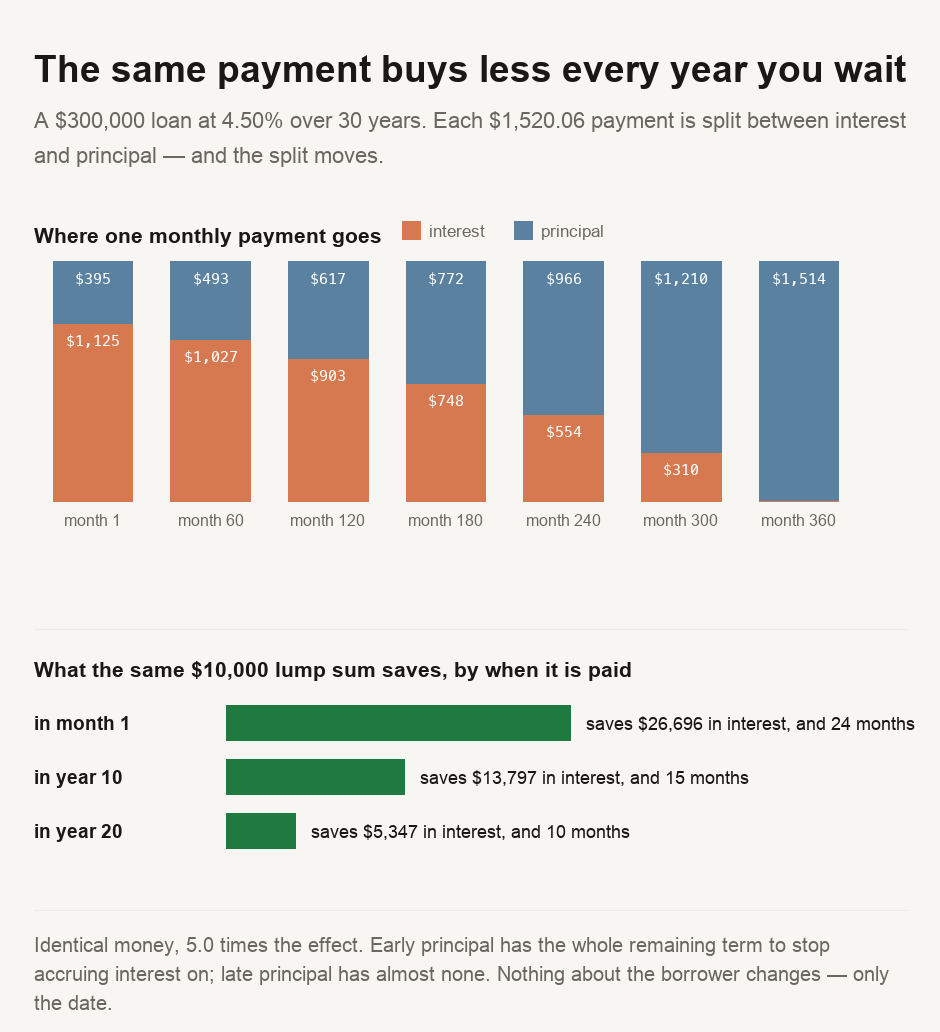
Now watch the split move. By month 180 — halfway — interest is $748 and principal is $772; that crossover is the first month more of your money goes to the debt than to the lender. By month 300 it is $310 against $1,210.
Your circumstances have not changed and the payment is the same. The only thing that moved was the balance the interest is charged on, and that is the entire mechanism.
Which makes an extra payment a bet on time, not on money
Put $10,000 into this loan in month one and you save $26,696 in interest and finish 24 months early. Put the same $10,000 in at year twenty and you save $5,347 and finish 10 months early.
Same money. Same loan. Same borrower. Five times the return, purely because of when it landed.
The reason is that a dollar of principal stops interest accruing for every month remaining. Paid in month one, it works for 359 more months. Paid in year twenty, it has 119 left. You are not really buying a discount — you are buying time on the meter, and the meter runs out.
Regular extra payments follow the same logic, with a twist worth knowing before you stretch. An extra $100 a month from the start cuts the term by 43 months and saves $34,086.61. Doubling it to $200 saves $59,436.41 — which is less than twice as much, not more.
That surprises people, and it is the same mechanism running in reverse. Overpaying harder finishes the loan sooner, which leaves fewer remaining months for the next dollar to save interest on. You are competing against your own progress. Five hundred a month saves $107,913.83 and ends the loan almost twelve years early — a great deal in absolute terms, and a worse deal per dollar than the first hundred was.
What this does not settle
The arithmetic is fixed. The decision is not, and three things sit entirely outside the sums.
Your rate against the alternative. Paying down a loan is a guaranteed, tax-free return equal to your interest rate. At 4.5 per cent that is a real and unexciting number. Whether an investment beats it is a forecast, not a fact, and anyone who tells you otherwise is selling the forecast.
Whether you can get the money back. Money inside a mortgage is gone until you sell or refinance. An emergency fund you can actually reach is worth more than the interest it fails to save, and the order — reserve first, then overpay — is the part people get backwards.
What your contract permits. Some loans charge a prepayment penalty, and some apply extra money to the next instalment rather than to the balance, which neuters the whole effect above. Read the clause; do not assume it.
We checked our own calculators against this, and we are naming the number
It would be poor form to publish arithmetic and then point you at our own tools without checking them, so we did. The model above was written from the definition, in a separate script, deliberately not derived from any calculator on this site — otherwise the check would be circular.
Then we drove the tools in a browser on that same loan. 4 of them, and all 4 returned $1,520.06 — agreeing with the reference to the cent, and with each other. Our loan calculator's total interest matched too, at $247,220.13. We hoped they would be right, and they were. On this input, our calculators work.
Two things we noticed anyway. The pages do not look like they agree. Two print whole currency units and two print to the cent; the currency symbols differ as well. A casual check would suggest a mismatch where none exists. And of the 13 loan pages we probed, only 2 expose their calculation in a way anything can test from outside — the rest keep it sealed inside the page, which is a known gap in how this site is tested rather than a defect in the sums.
We also did not check the other sixteen. An automated harness could not drive them reliably, and calling a tool correct when nothing ever got an answer out of it would be worse than admitting the sample was four.
Overpaying early is worth far more than overpaying later, and the gap is bigger than most people expect: on a $300,000 loan at 4.50 per cent, the same $10,000 saved $26,696 in month one and $5,347 in year twenty. So if you are going to do it, the argument for doing it now is stronger than the argument for the amount. But check three things first: your loan contract, for penalties and for how extra money is applied; your cash reserves, for the emergency that does not care about your mortgage; and your rate, to be sure it is worth beating. The arithmetic is settled; the decision is yours.
Running it on your own loan
Your rate and your remaining term are the only inputs that matter, and both are on your statement. Our loan amortization schedule will show you the month-by-month split for your own numbers, including the crossover month where principal finally overtakes interest — for the loan above it is month 180, and for yours it will not be. The extra payment calculator models a regular overpayment or a lump sum, and the loan calculator gives you the baseline to compare against. If you are weighing overpaying versus investing instead, payoff versus invest puts the two side by side rather than asserting a winner.
- Every figure comes from a script committed alongside this guide. It amortises the loan month by month in exact decimal arithmetic — interest is the balance times the monthly rate, and the loop runs until the balance reaches zero rather than assuming a closed form. It was written from the definition and deliberately not derived from any calculator on this site, because the audit below measures those calculators against it.
- The audit drove each tool in a real browser on the same loan. Where a page exposed its own calculation function, that function was called directly rather than reading rendered text, so the comparison is against the tool's arithmetic and not its formatting.
- ⚠️ Our first two attempts at that audit were wrong in a way that looked like a story. One matched currency with a pattern requiring two decimal places, and several of our pages print whole currency units — so the harness reported nine tools returning nothing. Another missed a button labelled "Generate schedule" because it only looked for "calculate". Both would have produced a confident and false finding that our own calculators were broken. The figures here are from a third run that verifies each tool actually responded before recording it.
- ⚠️ Four of twenty loan and mortgage tools were verified end to end. The remaining sixteen were not tested, and nothing here should be read as a statement about them.
- ⚠️ One loan, one rate, one term. The mechanism — that early principal has more remaining months to work on — holds everywhere, and the direction of every comparison here follows from it. The specific dollar amounts are this loan's.
This is general information about how amortising loans behave, not financial advice. It cannot know your rate, your contract, your tax position or your reserves, and all four change the answer.

View author profile → · Editorial policy