

An option's price moves for four reasons: the underlying price, the passage of time, expected future volatility, and interest rates. The Greeks are the dials that tell you how much the price responds to each of those, one at a time. Delta tracks the underlying, theta tracks time, vega tracks volatility, rho tracks rates, and gamma tracks how delta itself behaves as the underlying moves. Each is a partial derivative, which just means holding everything else still to see how one input affects the price. You do not need calculus to read them. This guide explains what the four main Greeks (and rho) measure, where their formulas come from, and how to read the numbers plainly.
Before anything else: this guide is general education, not investment advice. Options carry substantial risk, including the total loss of the money you put in, and some strategies can lose more than that. RECATOOLS is not a registered investment adviser, and nothing here is a recommendation to buy, sell, or trade any option. It explains how the Greeks behave, never what you should do with your own money. For that, talk to a licensed professional.
One model sits underneath all of them
The closed-form Greeks all come from the Black-Scholes-Merton model, which prices a European option — one that can be exercised only at expiry — from six inputs: the spot price S, the strike K, the time to expiry T in years, the risk-free rate r, the volatility σ, and a continuous dividend yield q. The model compresses S and K into two intermediate quantities that every formula below reuses:
d1 = ( ln(S/K) + (r − q + σ²/2)·T ) / ( σ·√T ), and d2 = d1 − σ·√T.
With no dividends, q is zero and d1 loses the −q term. That is the classic textbook form, and it is what our Option Greeks calculator falls back to at its default dividend yield of zero. The calculator keeps the q input so you can price a dividend-paying stock, but every formula in this guide is written first in the clean q = 0 version and then, where the dividend changes things, in the fuller Merton form the tool actually runs. If you want the price the Greeks are derived from rather than the sensitivities, our Black-Scholes calculator computes the call and put values from the same six inputs.
A couple of notes on the model itself. The normal distribution function N(·) that appears throughout has no elementary closed form, so both tools compute it with an Abramowitz & Stegun polynomial approximation, accurate to a maximum error around 7.5×10⁻⁸ rather than an exact evaluation. And the whole framework is European by construction. Most single-stock options listed in the United States are American-style and can be exercised early, which changes their true Greeks; the closed-form numbers here are the standard teaching model, not an exact description of an early-exercisable contract.
Delta: how much the price follows the underlying
Delta, the first Greek most people learn, answers a single question: if the underlying moves by one dollar, how much does the option's price move? It is also the one they most often misread. A delta of 0.54 means the option gains roughly 54 cents when the stock rises a dollar, and loses about that when it falls. Because a call gains as the stock rises, its delta is positive and lives between 0 and 1. A put gains as the stock falls, so its delta is negative, between −1 and 0.
The formula is short. In the classic q = 0 case, call delta = N(d1) and put delta = N(d1) − 1. When the stock pays a dividend, the calculator scales both by the discount factor: call delta = e^(−qT)·N(d1) and put delta = e^(−qT)·(N(d1) − 1). At the default q = 0 the discount factor is one and you are back to plain N(d1). Deep in the money, delta pushes toward ±1 — the option tracks the stock almost dollar for dollar. Deep out of the money it fades toward 0. At the money it sits close to ±0.5, which is why a coin-flip strike feels like half a share.
While delta is often described as the probability an option finishes in the money, that is a heuristic, not a fact. The actual risk-neutral probability is N(d2), whereas delta is N(d1)—a different, larger quantity. The two are close for near-the-money, short-dated options, which is how the shorthand survives, but they are not the same number, and reaching for delta when you mean N(d2) will mislead you on longer-dated or far-from-the-money contracts.
Gamma: how fast delta itself changes
Delta is not constant. As the underlying moves, delta moves too, and gamma measures that second move — it is the change in delta per one-dollar change in the stock. Delta is like the option's speed; gamma is its acceleration. A position with high gamma has a delta that shifts quickly, so a hedge you set this morning can be stale by lunch.
The formula uses the normal density φ, the bell curve's height, where φ(d1) = e^(−d1²/2)/√(2π):
Γ = φ(d1) / ( S·σ·√T ) in the q = 0 form, or Γ = e^(−qT)·φ(d1) / ( S·σ·√T ) with dividends.
Gamma is the same for a call and a put at the same strike and expiry, and it is always positive for a long option. Gamma is largest for at-the-money options and grows as expiry approaches. When traders say gamma "gets sharp," they mean a short-dated, at-the-money option's delta can swing from near 0 to near 1 on a small move in the stock. Our calculator shows gamma to five decimal places because the numbers are small; the other Greeks display to four.
Theta: what a day costs
Options lose value as time runs out, all else equal, and theta measures that bleed. It is the change in the option's price as one unit of time passes. For a long option theta is usually negative — you are paying rent on the optionality, and the rent comes due whether or not the stock moves.
The per-year theta has a shared first term and then a call-versus-put piece. Writing the shared term as Θ_common = −( S·φ(d1)·σ ) / ( 2·√T ), the textbook q = 0 forms are:
Call Θ (per year) = Θ_common − r·K·e^(−rT)·N(d2), and Put Θ (per year) = Θ_common + r·K·e^(−rT)·N(−d2).
The main point of convention—and debate—is how to turn the annual figure into a daily one. Our Option Greeks calculator divides the annual theta by 365, so its output is the value lost per calendar day. Some desks divide by 252, the count of trading days, which gives a larger daily figure for the same option. Neither is wrong, but they are not comparable, so any theta number is meaningless until you know its divisor — ours is 365. Decay is worst for at-the-money options and accelerates as expiry nears. One caveat worth keeping: "long options always have negative theta" is not quite true. A deep in-the-money European put is the classic exception where theta can turn positive, so say "usually negative" and mean it.
Theta is where the seller's side of the trade comes into focus. The person who wrote the option collects that daily decay as income, which is the logic behind a covered call — you own the stock and sell an option against it, banking theta in exchange for capping your upside. Our Covered Call calculator works through that payoff.
Vega: sensitivity to the market's nerves
Volatility is the one input you cannot read off a screen — it is the market's expectation of how much the underlying will move, and it changes as fear and calm cycle through. Vega measures how the option price responds to that. The raw partial derivative is per 1.00 of volatility, but nobody quotes it that way, so the calculator divides by 100 to show the price change per one-percentage-point move in volatility:
ν = S·φ(d1)·√T raw in the q = 0 form, then divided by 100 for display; with dividends the raw term is ν = S·e^(−qT)·φ(d1)·√T.
Like gamma, vega is identical for a call and a put at the same strike and expiry, and it is positive for a long option — buying an option is a bet that volatility, or the price of volatility, goes up. Vega is largest at the money and grows with time to expiry, which is why long-dated options are the volatility instruments and weekly options are mostly gamma and theta plays. A seller is typically short vega: they profit if implied volatility falls and lose if it spikes. Multi-leg structures built to be short volatility, such as an iron condor, live and die on this Greek; our Iron Condor calculator lays out that four-leg position.
Rho, briefly
Rho measures sensitivity to the risk-free rate, quoted per one-percentage-point change in r. The raw forms are call ρ = K·T·e^(−rT)·N(d2) and put ρ = −K·T·e^(−rT)·N(−d2), each divided by 100 for the per-1% display. Call rho is positive, put rho negative. For short-dated options rho is usually the smallest of the five and easy to ignore; it earns its keep on long-dated contracts, where a shift in rates has years to compound.
The four at a glance
A long-option summary, with signs and where each Greek is largest. The signs flip for a short (written) position — a seller is short gamma and short vega but collects theta.
| Greek | What it measures | Long call sign | Long put sign | Largest where |
|---|---|---|---|---|
| Delta | Price change per $1 move in the underlying | + (0 to 1) | − (−1 to 0) | Deep in the money (→ ±1) |
| Gamma | Change in delta per $1 move | + | + | At the money, near expiry |
| Theta | Value lost as one day passes | − (usually) | − (usually) | At the money, near expiry |
| Vega | Price change per 1% move in volatility | + | + | At the money, longer-dated |
A worked reading
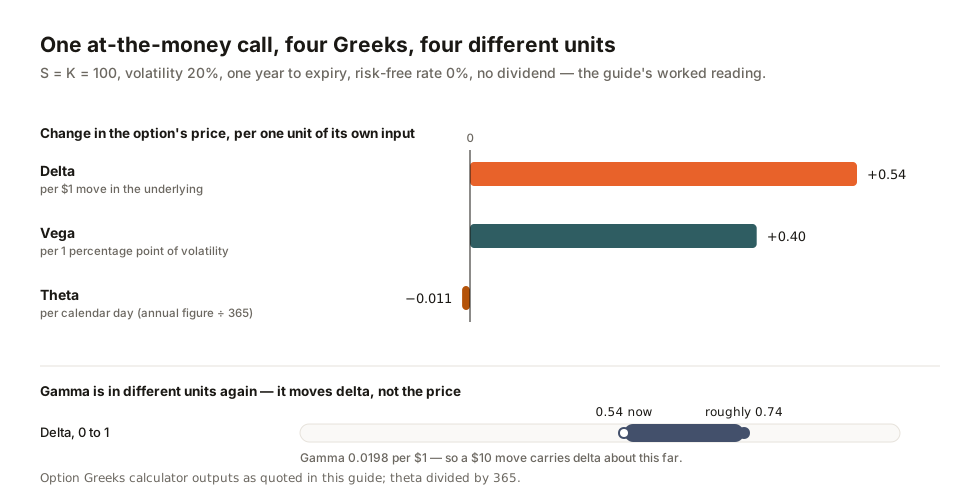
Numbers make the conventions concrete, so take a plain at-the-money case: S = K = 100, volatility σ = 20%, one year to expiry, a risk-free rate of 0%, and no dividend (q = 0). Feed those to the Option Greeks calculator and the call comes back near a delta of 0.54, a gamma of about 0.0198, a vega around 0.40, and a theta of roughly −0.011.
Read them in the units the tool uses. The delta of 0.54 says the call gains about 54 cents per dollar the stock rises — a touch above 0.5 because a year of upside volatility tilts an at-the-money call slightly bullish. Gamma of 0.0198 means each dollar the stock moves shifts that delta by about two hundredths, so a ten-dollar move would carry delta from 0.54 toward roughly 0.74. Vega of 0.40 is per percentage point: if implied volatility rises from 20% to 21%, the option gains about 40 cents. Theta of −0.011 is per calendar day, our ÷365 convention, so the option sheds a bit over a cent of value each day if nothing else changes. Change any input and all the numbers move. The Greeks are instantaneous readings, valid for a moment and obsolete as soon as the market shifts.
What the Greeks do not tell you
The precision of the formulas makes them easy to over-trust, but the model has important limits.
- They are European. Black-Scholes-Merton prices an option exercisable only at expiry. Most US single-stock options are American-style, and early exercise — especially around dividends — gives them Greeks the closed forms do not capture. Use the closed form as the teaching model, not as the exact truth about a listed American contract.
- They are approximate at the base. The normal distribution function is computed with a polynomial approximation, accurate to about seven decimal places but not exact. It is more than good enough to read the market by; it is not a reason to trust the eighth decimal.
- They are instantaneous. Every Greek is a snapshot sensitivity, valid for a small nudge around today's inputs. Gamma exists precisely because delta does not hold still; the same is true of every other Greek. A delta of 0.54 is not a promise about a twenty-dollar move.
- They assume the model's world. Constant volatility, a single rate, no transaction costs, continuous trading — the assumptions behind the closed form are cleaner than any real market. The Greeks inherit all of them.
A note for readers in the region
The math here is jurisdiction-neutral — a delta is a delta whether the option is listed in Chicago or Singapore. Worth knowing, though, that single-stock equity options are barely a retail product in ASEAN. SGX lists index derivatives and single-stock futures rather than a deep retail equity-options market, and Bursa Malaysia's index options lean institutional. Most people in Singapore or Malaysia who trade options do so on US-listed contracts through an international broker, where the liquidity and the single-stock universe actually exist. The Greeks work identically regardless of where the option is listed; only the access route differs.
FAQ
Is delta the probability my option finishes in the money?
Only roughly. Delta is N(d1); the risk-neutral probability a call expires in the money is N(d2), a different and smaller number. They are close for near-the-money, short-dated options, which is why the shorthand persists, but they diverge for longer-dated or far-from-the-money contracts. Use N(d2) if you actually want the probability.
Why does my theta look small compared to another site's?
Almost certainly the divisor. Theta is an annual figure until you scale it to a day, and our Option Greeks calculator divides by 365 calendar days. A site that divides by 252 trading days will print a larger daily number for the same option. The underlying value is identical; only the per-day convention differs.
Are gamma and vega different for calls and puts?
No. At the same strike and expiry, a call and a put share the same gamma and the same vega. Delta, theta and rho differ between them, but gamma and vega do not — a fact that falls straight out of the formulas.
Do these Greeks apply to American-style options?
Not exactly. The formulas here are Black-Scholes-Merton, which prices European options exercisable only at expiry. American options can be exercised early, so their true Greeks differ, particularly near dividends. Treat the closed-form numbers as the standard teaching model rather than an exact reading of an American contract.
- The Options Industry Council (OCC), "Understanding Options Greeks" — optionseducation.org (accessed 24 Jul 2026)
- Cboe Options Institute — options education and the Greeks (accessed 24 Jul 2026)
- Black & Scholes, "The Pricing of Options and Corporate Liabilities" — Journal of Political Economy 81(3):637–654, 1973 (accessed 24 Jul 2026)
- Merton, "Theory of Rational Option Pricing" — Bell Journal of Economics and Management Science 4(1):141–183, 1973 (accessed 24 Jul 2026)
- Hull, Options, Futures, and Other Derivatives, ch. 19 "The Greek Letters" — the standard reference for the closed-form Greeks (accessed 24 Jul 2026)
- SGX derivatives — index options and single-stock futures product pages (accessed 24 Jul 2026)
- Bursa Malaysia — FTSE Bursa Malaysia KLCI Options (OKLI) (accessed 24 Jul 2026)