The Nernst equation turns a ratio of concentrations into a voltage: the potential of an electrochemical cell at zero current, or the voltage that would exactly balance one ion across a membrane. Chemistry books print its constant as 0.0592 V and physiology notes as 61.5 mV, both per tenfold change, because one is worked at 25 °C and the other at 37 °C. On a standard teaching table, we found the 25 °C figure at body temperature is 2.3 to 3.5 mV out for potassium, sodium and chloride. Dropping chloride's minus sign is 150 mV out. So use the constant for the stated temperature, and in an exam the form your syllabus prints.
Allow 0.2 mV for each degree of temperature
Underneath both figures sits RT/F: the gas constant times the absolute temperature, divided by the Faraday constant. R and F are both exact in the 2022 CODATA values, so temperature is the only thing that moves. At 25 °C, RT/F is 25.69 mV per natural-log unit. Multiply by ln 10, about 2.303, for the slope per decade, or tenfold change. So the familiar constants are one quantity at two temperatures and two log bases. On our calculation the decade slope is 58.17 mV at 20 °C, 59.16 at 25 °C and 61.54 at 37 °C, climbing 0.198 mV per °C.
Exactly 298 K gives 59.13 mV and 298.15 K gives 59.16 mV, so 0.0592 belongs to 298.15 K, and 61.5 is 61.54 rounded. Cambridge's A-Level 9701 syllabus assumes 298 K and writes 0.059, which covers either value.
Flip the ratio to turn the chemist's form into the physiologist's
The chemist's form is E = E° − (RT/nF) ln Q. E° is the standard potential and Q the reaction quotient, products over reactants at that moment. The IUPAC Green Book defines n as the number of electrons in the balanced reaction and calls it "a positive integer". Cambridge's 2025–2027 and 2028–2030 syllabuses print E = E° + (0.059/z) log [oxidised species]/[reduced species], with z for those electrons. The plus sign and the inverted ratio cancel: for a half-reaction written as a reduction, Q is [reduced]/[oxidised].
Stony Brook University's open textbook Neurotext gives E = (61.5/z) log(out/in), where z is now the ion's signed charge: +1 for potassium, −1 for chloride. Treat the membrane, by analogy, as a concentration cell with the same ion on both sides. E° falls to zero, the ion passes from outside to inside, Q is [in]/[out], and the minus sign turns that into out/in. A negative ion feels the same voltage in the opposite direction, which is why z carries a sign and n never does.
Our Nernst equation calculator can run this bridge. With E° 0, n 1, Q 28.89 and 37 °C it returns −0.08989 V for potassium. Chloride takes n −1 and Q 0.06034 and returns −0.07504 V, with a warning that a signed n sits outside the redox definition. Here it only stands in for z. Until the fix of 1 November 2026 the page set each result's precision from the fewest significant figures among its inputs, n included, so its own Daniell example (E° 1.10, n 2, Q 10, 298 K) printed 1 V beside prose saying 1.07 V. The revised code prints 1.07 V.
Check chloride's sign before worrying about the temperature
Neurotext's table, which it calls "realistic values", has potassium at 130 mM inside and 4.5 mM outside, sodium at 15 and 140, and chloride at 7 and 116. We computed each ion at both temperatures, then the error at 37 °C from each shortcut. These are concentrations; the Green Book's equation uses activities, which part company in concentrated solutions.
| Ion (z) | 25 °C (mV) | 37 °C (mV) | Error using 59.16 | Using 58 |
|---|---|---|---|---|
| K⁺ (+1) | −86.42 | −89.89 | +3.48 | +5.17 |
| Na⁺ (+1) | +57.39 | +59.70 | −2.31 | −3.43 |
| Cl⁻ (−1) | −72.14 | −75.04 | +2.90 | +4.32 |
The 59.16 error is 3.9% of the true value for all three, a ratio of absolute temperatures. The 58 in some notes sits near the 20 °C slope.
Leave chloride's z at +1 and it reads +75 mV instead of −75.04, 150 mV out, about 43 times the worst temperature error here. For a doubly charged ion a z of 2 halves the slope, so leaving it out doubles the answer.
These are teaching figures for a textbook cell. A Nernst value is not a clinical reading, and nothing here interprets a blood test.
Treat potassium's value as a limit the membrane approaches
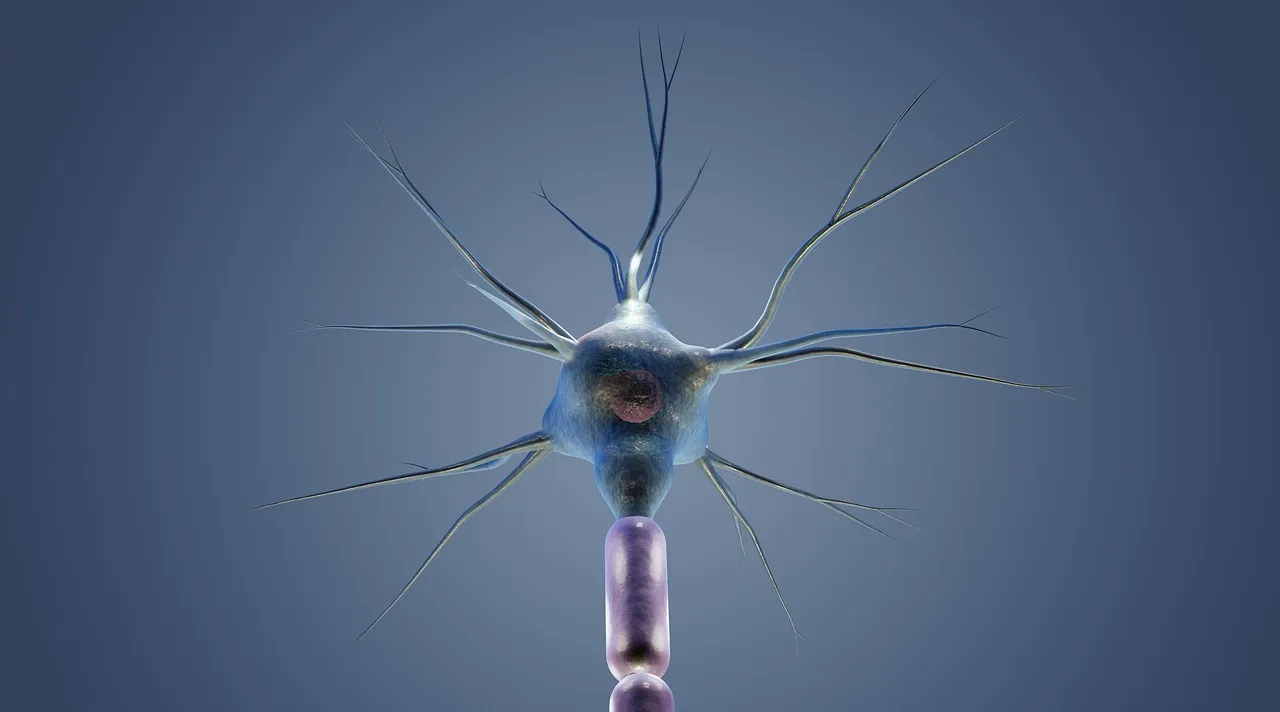
A Nernst potential is a theoretical limit for a single ion, assuming it's the only one that can cross the membrane. In reality, multiple ions are involved. Neurotext puts a typical neuron's resting potential near −70 mV and notes that at this voltage, "none of the ions are at equilibrium". Byrne's Neuroscience Online says rest can range between −80 and −40 mV depending on the type of nerve cell.
Goldman's equation weighs each ion by its permeability, how readily it crosses, and reduces to potassium's Nernst value if sodium's permeability is zero, as Byrne notes. We swept the sodium-to-potassium ratio on the same table at 37 °C, with chloride left out. The potential stays within 1 mV of potassium's value only while the ratio is below about 1 in 800, on this table. With sodium at 4% of potassium's permeability, a figure from squid axons, and chloride left out, the calculated potential sits 21 mV above it. With chloride it is 19.75 mV.
Reach for Goldman's form when several monovalent ions share a membrane
Nernst says where one ion would balance. Goldman estimates the voltage when several cross at once, with chloride's inside and outside swapped for its charge:
V = (RT/F) ln[(PK·K_out + PNa·Na_out + PCl·Cl_in) / (PK·K_in + PNa·Na_in + PCl·Cl_out)]
Alvarez and Latorre's 2017 review records that this is formally equivalent to Eq. 18 in Goldman's paper, and that Hodgkin and Katz in 1949 used potassium, sodium and chloride permeabilities of 1:0.04:0.45 at rest and 1:20:0.45 at the peak. On Neurotext's table those give −70.1 and +47.1 mV by our arithmetic. The first lands near Neurotext's −70 partly by luck: these are squid ratios on a mammal-style table, an illustration that confirms nothing.
The review also says divalent cations needed Fatt and Ginsborg's 1958 extension, so calcium does not simply join that sum.
Compare a Daniell cell, which a tenfold change moves about 30 mV
Cambridge's data booklet lists Cu²⁺/Cu at +0.34 V and Zn²⁺/Zn at −0.76 V, so a Daniell cell has E° 1.10 V, with n = 2. At 25 °C a tenfold rise in Q moves it 29.6 mV, or 2.7% of E°, on our arithmetic. Across eight decades of Q, from 0.0001 to 10,000, it runs from 1.218 V to 0.982 V. Those are zero-current values; the shift under current is overpotential, a separate term in the Green Book.
A tenfold change in potassium is 61.54 mV at 37 °C on the equation; Byrne reports "a 60 mV change". In an electrochemical cell, the logarithmic term merely adjusts a potential that is already near a volt. For a membrane, that term generates the entire potential.

View author profile → · Editorial policy