
Start with a number that should make you distrust numbers.
ChatGPT holds 4.7 out of 5 on G2, from more than two thousand business reviews. It holds 1.6 out of 5 on Trustpilot, from nearly two thousand eight hundred consumer ones. Same product, same period.
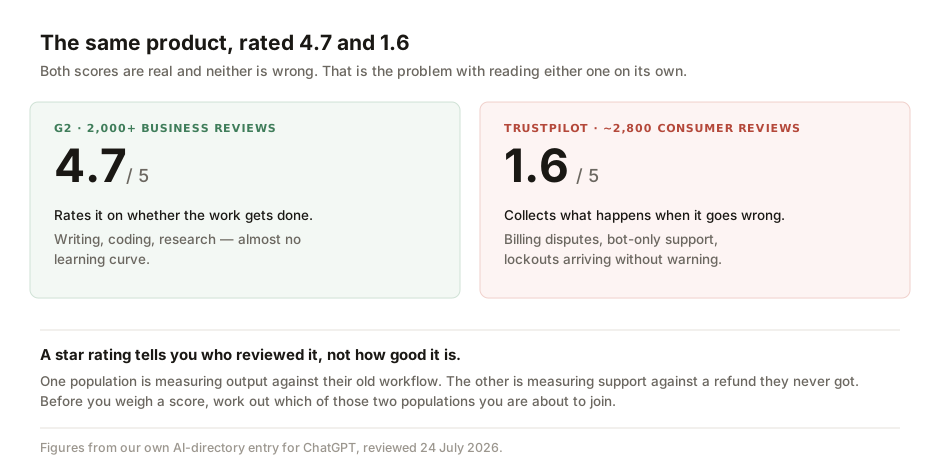
Neither score is wrong. Professionals rate the tool on whether the work gets done — writing, coding, research, with almost no learning curve. Trustpilot collects the other thing: billing disputes, bot-only support, image-generation lockouts that arrive without warning.
A star rating tells you more about who reviewed a product than how good it is. One population measured output against their old workflow. The other measured support against a refund they never received. Before weighing any score, work out which of those two groups you are about to join.
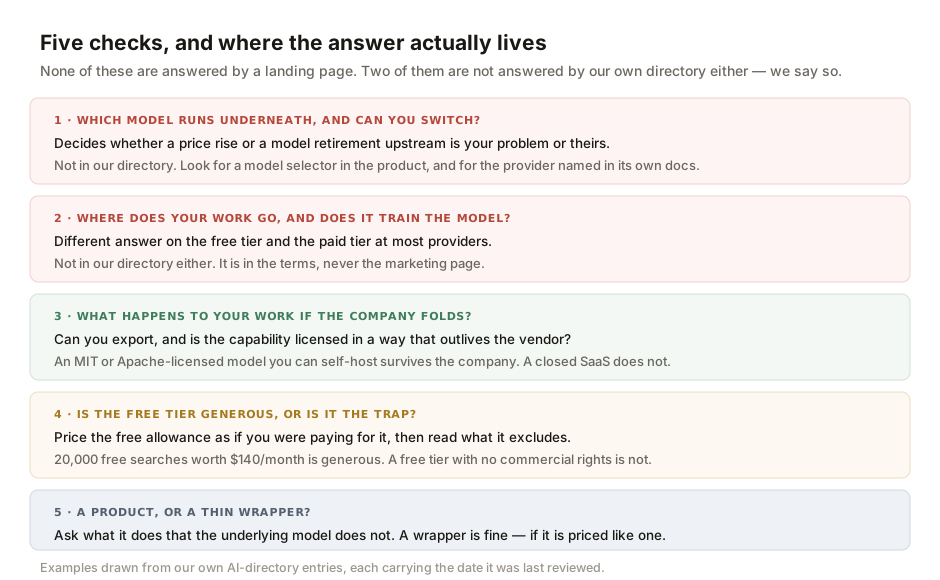
Instead, run these five checks to find the answers that matter. Two of them are not answered by our own directory, and we will say so when we get there.
1. Which model runs underneath, and can you switch?
Most AI products are an interface, a workflow and a prompt sitting on top of somebody else's model. That is not a criticism — the interface is often the valuable part. But it decides who owns your problem when something upstream changes.
If the product hard-wires one provider, then a price rise, a rate limit or a retired model is your problem. If it lets you switch, it is theirs. Freepik's image generator, for instance, lets users switch between several models from different vendors. You can change a project's look without changing platforms.
Where to find the answer: look for a model selector in the product itself, and for the provider named in its own documentation rather than its marketing. Our directory does not record this. We have no field for it. For a directory of AI products, that is a significant gap.
2. Where does your work go, and does it train the model?
The answer usually differs between the free tier and the paid tier at the same provider, which is exactly the detail a landing page will not carry.
This is worth reading properly rather than skimming, and it is a whole subject in itself — our guide on where your data actually goes works through the retention terms of the major providers and the jurisdiction question underneath them.
Where to find the answer: the terms, never the marketing page. Search the document for "train", "retain" and "delete". Our directory does not record this information, either. These two gaps are the most significant ones.
3. What happens to your work if the company folds?
Two sub-questions: can you get your data out, and does the capability survive the vendor?
Export is the easy half — either there is a button or there is not. The second half is about licensing, which produces sharply different risk profiles.
AI4Bharat is the instructive case. Its models are released under MIT and Apache 2.0 through HuggingFace and GitHub, there is no paid tier, and you can self-host or use a free public API. If the organisation stopped tomorrow, the weights you already have keep working. Compare that with any closed hosted product, where the company disappearing takes the capability with it.
This does not mean you should only use open models. It means you should know which kind you are depending on, and have a plan if a closed one vanishes.
4. Is the free tier generous, or is it the trap?
Both exist, and they look identical from the outside. The way to tell them apart is arithmetic.
Price the free allowance as if you were paying for it. Exa Search gives 20,000 search requests a month on its free plan and charges $7 per 1,000 requests after that. So the free tier is worth about $140 a month at list price. That is a working allowance, not a teaser.
Then read what the free tier excludes, because that is where traps live. Freepik's free tier is locked to its in-house model and carries no commercial rights — perfectly reasonable, and completely disqualifying if you were planning to use the output for client work.
The related risk is that terms change under you after you have committed. Freepik again, from our own entry: around the April 2026 rebrand, Premium+ subscribers saw their annual credit allotment fall from 1.6 million to 600,000 while the price went up, and several models previously marketed as "unlimited" quietly moved to credit-based billing. Users who had built a workflow on predictable per-request pricing found the arithmetic rewritten underneath them.
Worth checking on the same pass: where legal indemnity sits. On that platform, IP indemnification against third-party claims is available only on the Enterprise and Pro tiers, so anyone doing client work on a cheaper plan carries that risk personally. Few people read far enough down the pricing page to find that out.
5. Is it a product, or a thin wrapper?
The question is not whether it is a wrapper — many good products are. The question is what it does that the underlying model cannot.
A good wrapper does work the model cannot: it holds your data and context between sessions, integrates with systems you already use, enforces a workflow that stops you making a specific mistake, or handles the tedious setup around the API call. If the answer is only "it has a nicer box to type in", you are paying a margin on an API call you could make yourself, and you should at least know that is the trade.
The practical test: take the thing you actually need done, and try it in a general-purpose assistant first. If the assistant does it about as well, the wrapper is selling you convenience, and convenience is worth paying for only at convenience prices.
Which model underneath, and can you switch? Decides whose problem an upstream change is. Where does your work go? In the terms, and usually different on free and paid. What if the company folds? Export plus licensing — an openly licensed model you can self-host outlives its maker. Free tier: gift or trap? Price the allowance, then read the exclusions. Product or wrapper? Ask what it adds beyond the model, and price it accordingly.
None of these are answered by a landing page. Two of them are not answered by our directory either, and the honest thing is to tell you that rather than imply otherwise.
What our directory is, and is not, good for
We keep an AI directory of more than 1,300 products. It is useful for some of the checks above and useless for others. Knowing which is which will save you time.
- Use it for pricing. Entries carry specific free-tier and paid-from detail, not "starts from" marketing language — the actual allowance and what it excludes.
- Use it for complaints. Each review summary is written from what people actually report, unflattering parts included, and carries the date it was last reviewed so you can judge its age.
- Use it for regional detail. Many entries note ASEAN availability, accepted currencies and language handling — the details international coverage usually skips.
- Do not use it for the underlying model. We have no field for it. If that matters to your decision, the product's own documentation is where to go.
- Do not use it for data handling. Again, no field. Read the terms, or start with our data guide, which does that work for the major providers.
- Check the date on anything. Pricing in this market changes fast. Every entry shows when it was last reviewed; treat anything older than a few months as a starting point rather than a quote.
If cost is the deciding factor and you are comparing model providers rather than finished products, our LLM price comparison puts the per-token prices side by side, which is a different and more tractable question than comparing whole products.
And a final sceptical note: since this guide has told you not to trust marketing, apply the same standard here. Every figure above is sourced from our own directory entries and carries the date those entries were reviewed. Prices and terms in this market move faster than any directory updates, ours included. Check the number against the vendor before it changes a decision.
- The G2 and Trustpilot figures for ChatGPT, and the description of what each review population measures, are from our own AI-directory entry for ChatGPT, last reviewed 24 July 2026.
- The Freepik credit reduction at the April 2026 rebrand, the free tier's restriction to the in-house model without commercial rights, and the placement of IP indemnification on the Enterprise and Pro tiers only, are from our directory entry for Freepik's AI image generator, last reviewed 11 July 2026.
- Exa Search's free allowance of 20,000 monthly requests and its $7 per 1,000 request paid rate are from the pricing fields of our directory entry, last reviewed 11 July 2026 and reflecting the March 2026 pricing update.
- AI4Bharat's MIT and Apache 2.0 licensing, absence of a paid tier and self-hosting option are from our directory entry, last reviewed 11 July 2026.
- Directory coverage figures — more than 1,300 entries, and the absence of any field recording underlying model or data handling — were measured against the production database on 1 August 2026.
General guidance on evaluating software, not a recommendation of or against any named product. Pricing, terms and free-tier limits in this market change frequently and several of the figures above document changes that happened mid-contract; verify anything that matters against the vendor's own current terms before committing.

View author profile → · Editorial policy