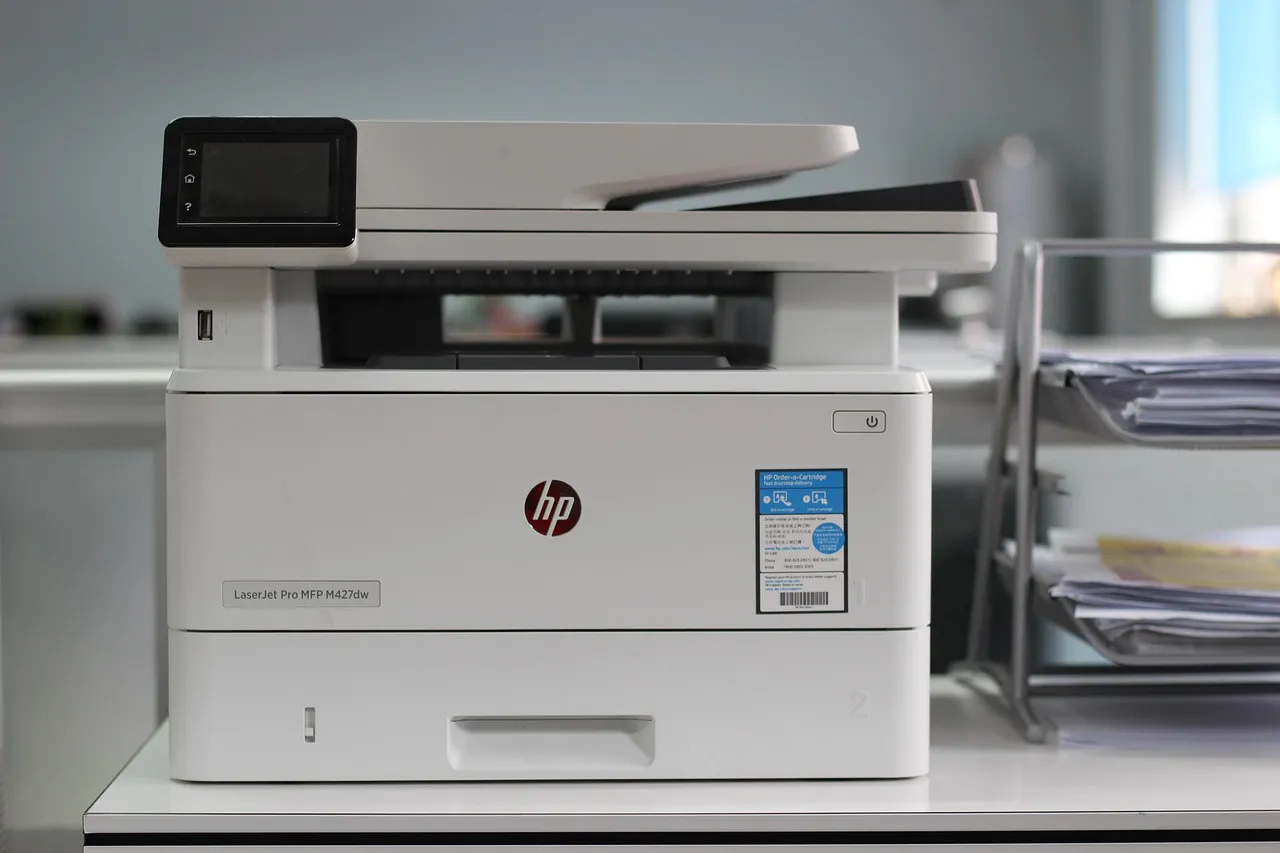
Photocopiers across the region carry a 141% button and a 71% button. Those two numbers are the square root of two and its reciprocal, and they are on the machine because A4 was designed so they would work.
US Letter has no such number, and the reason is not that someone chose differently. Nobody appears to have chosen at all.
Two constraints, one answer
The ISO 216 standard defines the entire A series of paper sizes with just two constraints: the ratio of the long side to the short is the square root of two, and the base size, A0, has an area of one square metre.
Those two constraints permit only one solution. The width works out to 2 to the power of minus one quarter and the height to 2 to the power of one quarter, or 840.8964 by 1189.2071 millimetres. The standard states the solved values to three decimal places and rounds them to whole millimetres for the table.
The rounding rule is not what most people assume. Flooring at every step would make A0 840 millimetres wide, and the standard says 841. The rule that reproduces the published tables is round to nearest at A0, then halve and round down thereafter — a floor that guarantees two smaller sheets are never larger than the parent, so halving is always safe and occasionally loses a fraction of a millimetre. A5 is the visible case: half of 297 is 148.5, and the table says 148.
A common mistake is to assume A0 is exactly one square metre. Because of the rounding, 841 by 1189 millimetres is 0.999949 m². The one-metre area is a constraint on the ideal, not a property of the final trimmed sheet.
Why the square root of two and nothing else
Take a sheet whose long side divided by its short side is r. Cut it in half across the long side and the new ratio is 2 divided by r. For the halves to have the same shape as the parent, r must equal 2 over r, so r squared is 2.
Because there is only one positive solution, no other ratio works. The golden ratio, which people often bring up, cannot do the same job. Halve a golden-ratio sheet and you get 1.236, not 1.618.
The confusion is understandable. The golden ratio is also self-similar, but through a different operation: removing a square from a golden rectangle leaves a smaller one behind. Only the square root of two is self-similar under the operation a printer actually performs.
The 1972 study of American paper sizes, unconstrained by the language of a standards document, puts it bluntly:
"There is no magic in this proportion… there is no rectangle of any other proportion than that which bears the width/length ratio of 1:1.414 that can be halved and halved and halved again without changing the proportions of its two sides."
The buttons on the copier, decoded
141% is the square root of two and takes A4 to A3. 71% is its reciprocal and comes back. 119% and 84% are the fourth root of two and its reciprocal, moving between the A and ISO B series.
Machines sold in this region also carry presets like 122%, 115%, 87%, 82% and 61%. These are not powers of the square root of two. They belong to the Japanese B series, which is built on a different constraint — its B0 is 1.5 square metres, an arithmetic rather than geometric relationship to A. A manufacturer's own manual lists 122% as A4 to B4 and maps the same button to the 8 by 13 inch size, which is why it appears on machines sold across South East Asia.
The international B series has a different definition again: each B sits at the geometric mean of the A sizes on either side. B4's short side works out to exactly 250 millimetres from the unrounded A values — though doing that calculation on the rounded integers gives 249.74, which is a good way to look wrong by a quarter millimetre.
The envelope series is not in the standard
C4 takes an unfolded A4, C5 takes it folded once, C6 folded twice. C-series envelopes are used with A-series paper, but they are not defined in ISO 216. The standard's own title names only the A and B series, and the word "envelope" does not appear in it.
The C series lived in a separate standard which has since been withdrawn with no successor. It survives in national standards rather than an international one. The common DL envelope is not a C size either, and not a square-root-of-two format: at 110 by 220 millimetres its ratio is exactly 2.
The murky origins of US Letter
Letter is 8.5 by 11 inches, a ratio of 1.294. The story usually told is that it descends from a quarter of a sheet a papermaker could lift, or from the span of a vatman's arms.
That account traces to a single industry page — filed, tellingly, under "fun facts". Its own trade association's spokesman has since described it to a radio programme as industry folklore. The 1972 study the page cites as its authority contradicts it, recording that there appear to be no records showing the basis on which the standard was developed, and that no actual analysis is in existence. And the page's arithmetic does not work: a 44-inch mould quartered gives four sheets of 11 by 17, not 8.5 by 11.
What is documented is duller and more honest. A 1921 committee on simplification recommended a set of basic sizes that were, in the study's words, simply common to the industry at the time. Letter is one of those — 17 by 22 inches, quartered. Legal is 17 by 28, quartered. The committee ratified what already existed.
American government offices used 8 by 10.5 inches from 1921 until the 216 by 279 millimetre size replaced it around 1980. The interdepartmental body that standardised federal printing is real and well attested — the Public Printer's annual reports for 1921 and 1922 describe its formation and its work on standardising forms — though the specific date and the dimension itself rest on that same 1972 study rather than on any government document found since.
The later change is stranger. No instrument for this change appears in the searchable federal record. A full-text search of the Federal Register, which runs from 1936, returns nothing for the period, and the executive-order tables that could be loaded mention no order about paper or letterhead, either.
The version everyone repeats — that Reagan ordered it in 1980 — is not a claim anybody made. One widely read source says only "the early 1980s" and cites a link that is now dead. Another gives January 1980 and names no president and no source. Neither says what the two of them are quoted as saying together, and January 1980 falls in Carter's term in any case. The sentence was assembled downstream out of two separately unsupported halves, which is a tidy demonstration of how an uncited claim hardens into a fact.
Letter is smaller, and it clips in both directions
| A4 | Letter | |
|---|---|---|
| Dimensions | 210 × 297 mm | 215.9 × 279.4 mm |
| Ratio | 1.4143 | 1.2941 |
| Area | 0.06237 m² | 0.06032 m² |
Letter is 5.9 millimetres wider, 17.6 shorter, and 3.28% smaller in area — so "Letter is the bigger one" is wrong. The printing consequence runs both ways: A4 content on Letter loses about 17.6 millimetres off the bottom, and Letter content on A4 has room at the bottom but is 5.9 millimetres too wide, so it clips at the sides. That asymmetry is why "fit to page" scales A4 down by about 94% rather than doing nothing.
The inch system gives up constant proportionality. Halving a Letter sheet, ratio 1.2941, produces a shape with a ratio of 1.5455 — exactly the next American drawing size. The series alternates between two shapes instead of preserving one.
Two countries are running two official paper sizes at once
The Philippines has the sharper version of this: two contradictory official standards, live at once.
A joint memorandum circular of 1 August 1986, signed by the ministry of general services, the commission on audit and the product standards agency, abolished the long and short bond sizes — 8 by 13 inches and 8 by 10.5 — and required A4 for government writing paper. Its enforcement clause has teeth: purchases of bond paper not in A4 shall not be approved and passed in audit.
Note which size was banned. The "short" size, 8 by 10.5 inches, is precisely the American government letter size, abolished in a former American colony as part of a metrication programme.
Against that, the Supreme Court's Efficient Use of Paper Rule, effective January 2013, requires pleadings on 13-inch by 8.5-inch white bond paper. That is long bond, the size the 1986 circular set out to abolish, mandated by the judiciary a quarter of a century later. The court's own published documents measure 8.52 by 13 inches, so the rule is followed in practice as well as in text.
A claim circulating widely says Philippine courts have since moved to A4. It could not be traced to any instrument, and the sites carrying it are automated legal-content farms. The 2019 rules of civil procedure, sometimes cited for the change, specify no paper size at all — a full-text search of the court's own 316-page release returns nothing on the subject.
Long bond at 8.5 by 13 inches is 215.9 by 330.2 millimetres. Indonesia has the same split running and leaves it wider open. Its national archives rule, still in force, puts regulatory texts on F4 and ordinary letters on A4. The rule requires the paper to survive a tear of at least 350 millinewtons and to sit between pH 7.5 and 10, and across 114 pages it never once says how big F4 is. The file the archives agency publishes it as is laid out at 8.5 by 13 inches — long bond, not the A4 its own article 69 gives correspondence. Vietnam went the other way and mandated A4 outright for administrative documents in a 2020 decree.
What to do at the print dialogue
When printing a document from the other system, scaling is not optional. It is the only way to keep content off a clipped edge — and which edge depends on the direction of the conversion.
In the Philippines, the official paper size depends on which office is receiving the document. An audit-facing purchase and a court filing are governed by instruments that disagree.
Where the numbers and the quotations come from
The constraints, the solved dimensions, both dimension tables and the tolerances are from ISO 216:2007 itself, read from the publisher's own preview of the full text. The history is from the German standards body's published account of the format's origins, which names the engineer behind the 1922 standard, and from the scholarly edition of Lichtenberg's correspondence for his 1786 letter setting out the ratio — whose editors note he was probably not first to it. The copier percentages are from a manufacturer's operating instructions. The American material is from a 1972 study of paper sizes, with the folklore attribution and its retraction from the trade association's own page and a radio interview with its executive. The Philippine instruments are the joint memorandum circular of 1986 and the Supreme Court's Efficient Use of Paper Rule, the latter quoted from an official government issuance reproducing it. The Indonesian rule is the national archives' general guidelines on official documents, regulation 5 of 2021, articles 68 and 69, read from the agency's own legal-documentation portal, which records it as in force; its page size is the one declared in that published file. Vietnam is decree 30/2020. All were read on 20 September 2026.
Three gaps are left open rather than filled. The rounding rule is nowhere stated in ISO 216 — it is reverse-engineered from the tables, and the only published derivation is a personal academic page, though the rule reproduces all three series exactly. The date American government offices adopted Letter is unpinned, as described above. And no national standard number could be confirmed for ISO 216 adoption in the Philippines, Singapore, Malaysia, Indonesia or Thailand, because the relevant standards portals either time out or paywall their catalogues; the regional picture here therefore rests on the instruments quoted rather than on a list of adoptions.

View author profile → · Editorial policy