Kenji Tanaka is a RECATOOLS editorial persona focused on developer tools, cloud platforms, DevOps, CI/CD, software supply chains, and infrastructure trends. Articles under this byline help technical readers understand how tooling changes affect software delivery, security, cost, and reliability.

About this byline

Kenji Tanaka is a RECATOOLS editorial persona for developer tools, cloud, DevOps, and software supply-chain coverage. Articles are produced and reviewed under RECATOOLS editorial supervision.

Editorial responsibility for this byline rests with Jeffrey Tan (Tan Seng Fei), RECASYS, Singapore. Our Editorial Policy sets out how sources are reviewed, how AI-assisted workflows are used, and how editorial desks and personas are defined.

347
Articles
Cybersecurity
Primary beat
May 2026
Writing since
~2446 min
Total reading

Articles · Developer Tools Showing 71–80 of 94

Someone holding a large printed landscape photograph in front of a monitor showing a grid of images.
Developer Tools

Which Image Format, and Why Your Photos Are Too Big

One of our own hero photos was 198,372 bytes. It is 59,766 now — same photograph, same dimensions; we finally compressed it. The file was never big because JPEG is the wrong format, it was big because nobody compressed it. Plus what each format is actually for, the AVIF trap our own converter fell into, and a correction to what we first reported about our own page weight.

1 Aug 2026 · 15 min read
Close-up of a heavy chain in which one link is visibly more worn than its neighbours — illustrating a fix that depends on an older underlying library.
Developer Tools

A Critical Rails Flaw Reads Your Server's Files From an Image Upload — and Patching Rails Is Not Enough

CVE-2026-66066 scores 9.5 and needs no authentication. The fix depends on a libvips version many deployments do not have, and patched Rails refuses to boot without it.

1 Aug 2026 · 5 min read
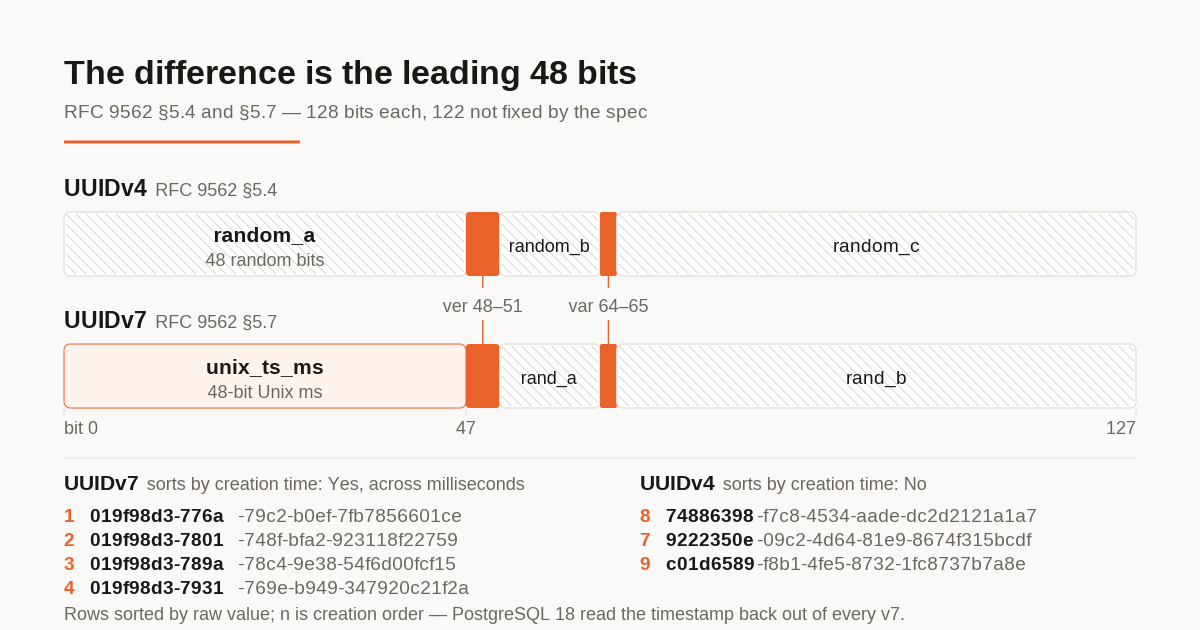
The 128-bit layouts of UUID v4 and v7 side by side, differing only in the leading 48 bits: random in a v4, a Unix millisecond timestamp in a v7.
Developer Tools

UUID v4 vs v7 in 2026: v1 Was Never the Sortable One

RFC 9562 replaced RFC 4122 in May 2024, and the advice most codebases still follow did not update with it. UUID v1 is time-based but not time-sortable: its leading field is time_low, which wraps every 429.4967 seconds — sixty v1s generated a minute apart came out 59 of 60 out of sorted order in our own run, against 0 for the same instants as v7. Plus the v4 collision arithmetic done properly (a billion a second for 100 years is 60.80%, not "less than 50%"), and the index-locality mechanism in the database vendors' own words.

25 Jul 2026 · 19 min read
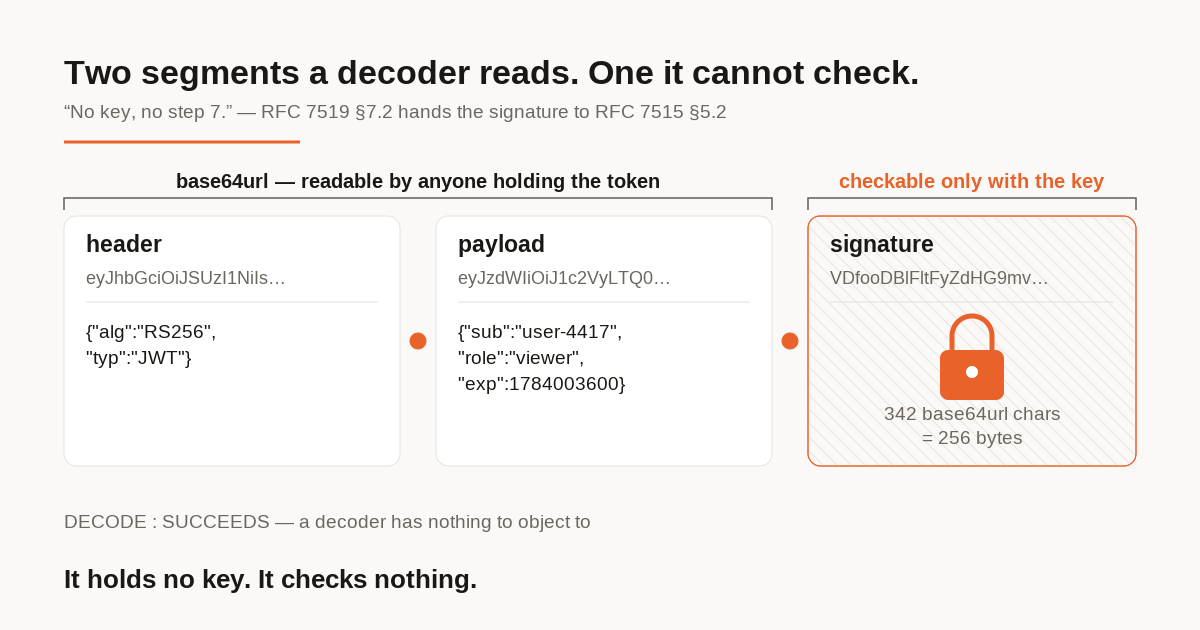
A JWT split into three panels: header and payload shown decoded and readable, the signature panel hatched and padlocked as checkable only with the key.
Developer Tools

Decoding a JWT Is Not Verifying It

A decoder shows you the claims; it does not tell you whether to believe them. RFC 7519 §7.2 lists ten validation steps and a browser page can perform six — step 7, the signature, needs a key it does not have. It closes with captured container runs showing a tampered payload decoding perfectly while verification fails, an alg:none forgery and an RS256-to-HS256 key confusion sailing past a decoder, and the morning we found our own tool stamping an unsigned admin token "Valid".

25 Jul 2026 · 17 min read
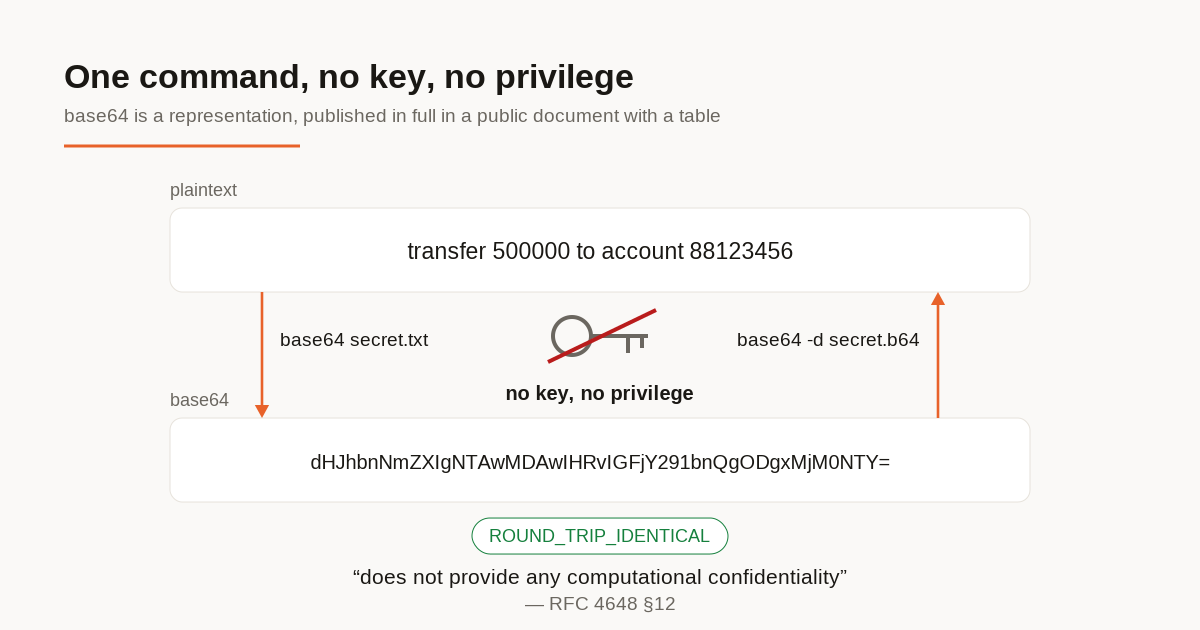
A sentence encoded to base64 and decoded straight back, with a struck-through key between the two arrows marking that no key is involved.
Developer Tools

Encoding Is Not Encryption: Base64, Percent-Encoding and the Confusion That Leaks Data

The RFC that defines Base64 says in its own Security Considerations that base encoding "visually hides" a password but "does not provide any computational confidentiality" — and names the exact leak scenario. We reverse the IETF's own worked Basic-auth credential with one command and no key, measure the size tax at +33.3351% on a real 76,766-byte PNG, and then settle the quieter confusion: why + means a space in form data but a literal plus sign in a URL.

25 Jul 2026 · 16 min read
A spider web strung with dew drops — a self-hosted crawler for the open web
Developer Tools

Self-Host Firecrawl with Docker: Scrape the Web into LLM-Ready Markdown (2026)

We cloned Firecrawl v2.11.0, built its seven-service Docker stack, and scraped our own homepage into clean markdown — no API key, no cloud account.

21 Jul 2026 · 16 min read
Industrial automation line glowing orange — n8n automates the plumbing between your systems
Developer Tools

Self-Host n8n with Docker: From Zero to Your First Webhook (2026)

One container, one volume, one real webhook: we self-hosted n8n 2.30.8 with Docker on macOS and captured every command, including the teardown.

21 Jul 2026 · 14 min read
A workspace mid-install — setting up Hermes Agent takes one command
Developer Tools

How to Set Up Hermes Agent on a Mac (2026)

Executed walkthrough of installing Hermes Agent v0.18.2 on macOS: the official script, the PATH gotcha, doctor checks, and picking a model provider.

15 Jul 2026 · 9 min read
Code on a dark screen — OpenCode is a coding agent that lives in your terminal
Developer Tools

How to Set Up OpenCode on a Mac (2026)

Executed walkthrough of OpenCode v1.18.1 on macOS: Homebrew install, provider auth, free local Ollama option, first run — every command verified.

15 Jul 2026 · 9 min read
The npm logo, a white wordmark on a red background
Developer Tools

npm v12 Is Here, and It Turns Off a Default That Has Run Arbitrary Code for a Decade

npm v12 went generally available on 8 July, flipping install scripts, Git dependencies and remote-URL packages from automatic to opt-in. The default is softer than the headlines suggest — but native builds are where teams will feel it.

11 Jul 2026 · 6 min read
Editorial Policy →
Advertisement