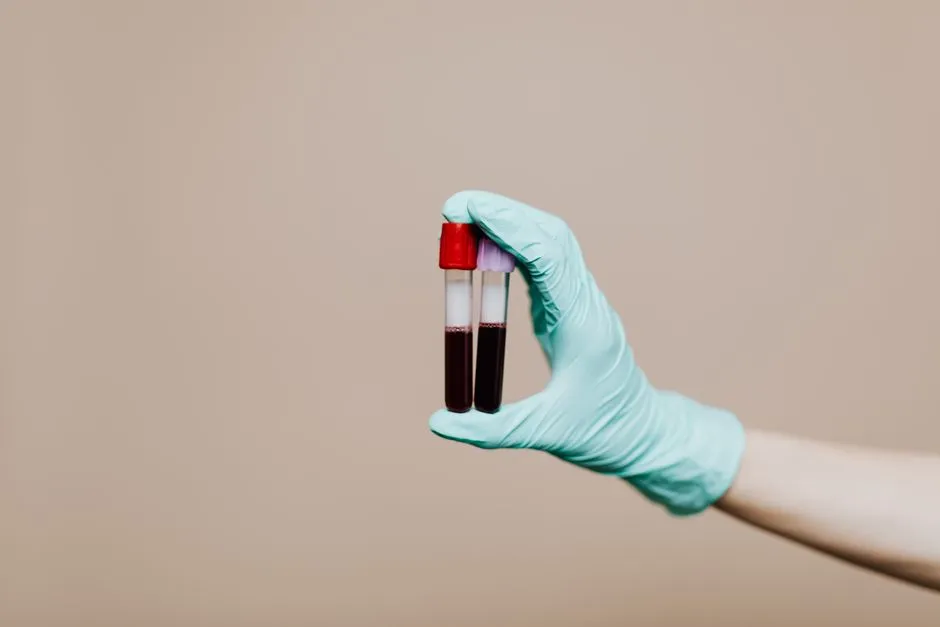
18 SEP 2026 — A blood test for pancreatic cancer found 86.8 per cent of early-stage disease in a study of 1,649 patients. Among the high-risk controls, the people such a test would actually be given to, it called 15.6 per cent positive who did not have cancer.
Both numbers come from the same paper, published in Nature Medicine on 16 September. The false-positive rate is what decides whether this becomes a clinical tool.
What the test measures
PANXEON combines a thirteen-microRNA signature with CA19-9, the protein marker already used in pancreatic cancer care. Five of the microRNAs circulate freely in plasma and eight are carried inside exosomes, and a machine-learning model reduces the measurements to a single composite score.
The study ran across twelve institutions in the United States, Japan, Italy and South Korea. Of 1,785 people initially enrolled, 1,757 plasma samples from 1,649 patients survived quality control and were analysed across training, validation, independent testing, treatment-monitoring and cross-reactivity cohorts.
The microRNA signature alone detected 83.8 per cent of stage I and II disease with an area under the curve of 88.6 per cent. Adding CA19-9 lifted detection to 86.8 per cent. That is a three-point gain from the component already in clinical use, worth remembering when reading the composite figure.
The number that decides it
False-positive rates came in at 3.2 per cent among low-risk controls and 15.6 per cent among high-risk controls.
The five-fold difference is less a flaw in the test than a description of who it is for. Nobody proposes screening the general population for a cancer this rare. The candidates are people with pancreatic cysts, a strong family history or new-onset diabetes of a particular pattern, and that is the group where the test misfires most often.
Suneel Kamath put the arithmetic plainly, warning that for a disease this rare, even a test with 90 per cent sensitivity can carry a poor positive predictive value, and that sensitivity probably needs to reach the mid-nineties to be clinically useful. He also flagged training-set curves of 97 to 98 per cent as a possible sign of overfitting.
A positive result here does not mean cancer. It means a scan, and possibly a procedure, for roughly one in six high-risk people who do not have the disease.
What it found before the cancer
The test also produced a notable result on precancerous lesions. In patients with pancreatic cysts, the test identified 64.3 per cent of high-grade dysplasia, and the signal came from the microRNA component rather than from CA19-9. In cysts without high-grade dysplasia, 75.5 per cent of results were negative.
Detecting a lesion before it turns invasive is a different proposition from detecting early cancer, because the intervention is different and the window is longer. It is also where the sample is thinnest. The cohort was small and limited to patients who went to surgery, a selection bias towards cases someone had already decided to operate on.
Surveillance, not screening
The authors position the findings as a possible surveillance role for people already at elevated risk, not as screening for the general population.
Ajay Goel of City of Hope went further on what a result means: "A positive PANXEON result should not be interpreted as a diagnosis of pancreatic cancer and certainly should not, by itself, lead to surgery."
That is a researcher constraining his own finding in advance, and it is the right instinct for a disease where the surgery is major and the anxiety generated by a positive result is real. The stated limitations run the same way: age differences between patients and some controls, limited representation of Hispanic and African American patients, and no way to establish how long before clinical diagnosis the molecular signal appears.
What to watch
Lead time is the clinical question. The study cannot say how far ahead of diagnosis the signature becomes detectable, and that interval is the entire clinical value of an early-detection test. A marker that appears three months early changes little; one that appears two years early changes everything.
The false-positive rate in the high-risk cohort is the number that has to come down, and it is the hardest to improve, because the surveillance population contains exactly the pancreatic abnormalities most likely to look like disease.
Who is studied next also matters. Twelve institutions across four countries is an international dataset by the standards of this field, and it still under-represents several populations the authors name. Our reporting on a lung-cancer model whose scores fell outside its training population is the standing reminder that a validation cohort is part of the result, not a footnote to it.

View author profile → · Editorial policy