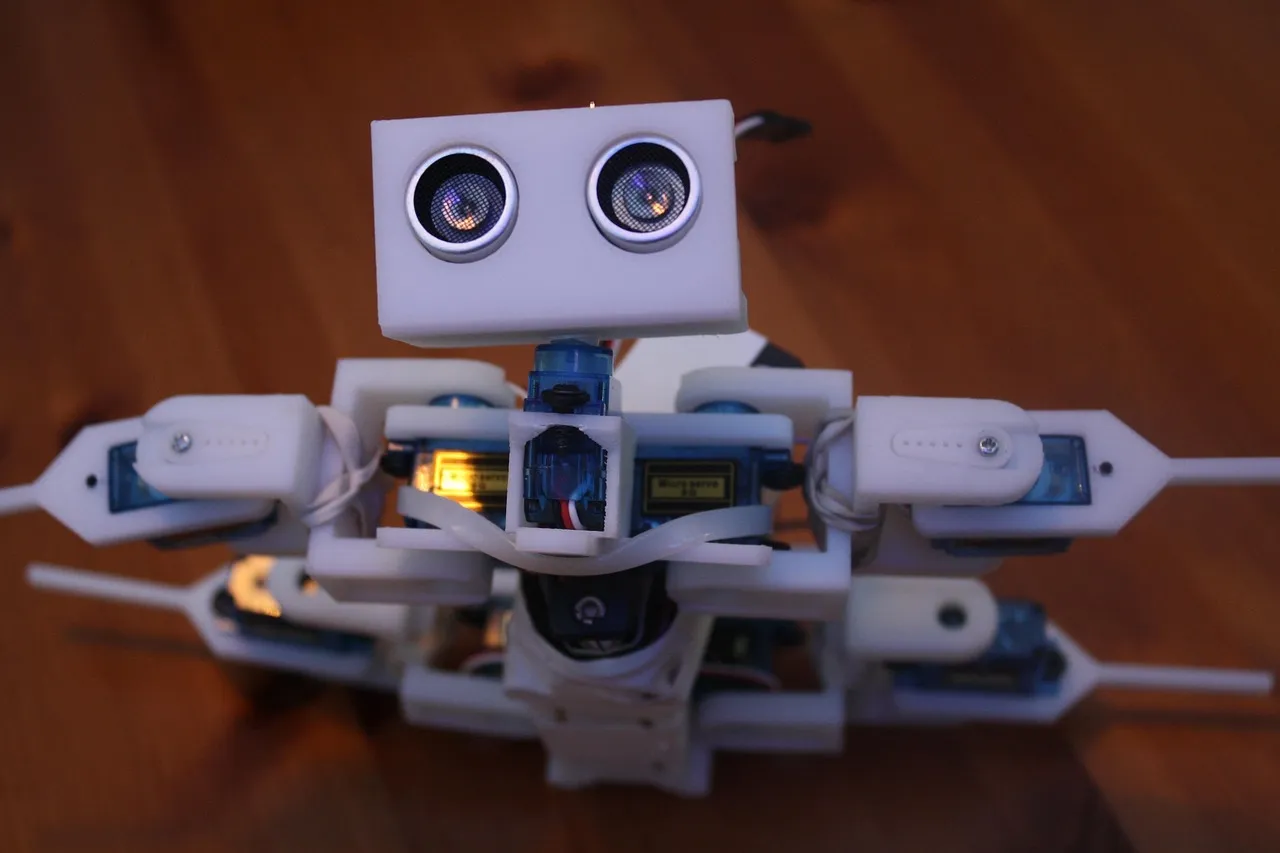
PARIS, 29 AUG 2026 — Hugging Face and Pollen Robotics have opened pre-orders for Microduck, a 25cm bipedal robot at US$399. The hardware is the least interesting part. The training environments, reward functions and sim-to-real recipe are all published on GitHub.
What you get for US$399
The robot stands 25 centimetres, weighs around 800 grams and carries 15 motors, a wide-angle camera, a compact lidar in the form of an 8×8 time-of-flight matrix, microphones, a speaker, two inertial measurement units, NFC, Wi-Fi and Bluetooth. Its articulated beak works as a small gripper, so it can pick things up as well as walk.
Pre-orders opened at an introductory US$399 before taxes and shipping, with first deliveries targeted before Christmas 2026. Both of those qualifiers matter for anyone budgeting: the headline price is a pre-order price and it is not landed cost.
What "open source" means here, unusually
The phrase is applied loosely to robots. It often means the CAD files are downloadable while the control software is a binary, or that a permissive licence covers a wrapper around a closed stack.
This release is not that. Apache 2.0 covers the control stack, the training pipeline and all seven shipped policies. Beyond the code, the training environments, the reward functions, the domain-randomisation settings and the sim-to-real recipe are public on GitHub.
That list is the substantive part. Anyone can publish a trained policy, and running it teaches you nothing about how it was produced. Publishing the reward function tells you what behaviour was actually being optimised. Publishing the domain-randomisation settings tells you which variations in mass, friction, latency and sensor noise the policy was hardened against. Publishing the sim-to-real recipe tells you how the gap between simulator and hardware was closed.
These are the parts robotics groups normally keep, because they represent the difficult work and a competitor's development time.
Why a small biped is a reasonable teaching platform
A 25cm robot that falls over is a robot that gets picked up. A 1.5-metre humanoid that falls over is a repair bill and, in a shared lab, a safety incident.
That asymmetry is the main argument for this form factor in education. Reinforcement learning on physical hardware requires many failures, and the cost of a failure sets how many you can afford. At this scale a student can run a policy that does not work yet, repeatedly, without institutional consequence.
The sensing choice fits the same logic. An 8×8 time-of-flight matrix is a very low-resolution depth sensor by any standard, and it is enough to learn obstacle avoidance and terrain estimation on. Learning to work with sparse, noisy range data is closer to the real constraint in deployed robotics than learning with a dense scanner would be.
What this competes with, and what it does not
At US$399 the comparison set is not other humanoids. It is the Raspberry Pi robot kits, the educational arms and the hobby quadrupeds that occupy the two-to-six-hundred-dollar band.
Against those, the differentiator is that this ships as a reinforcement-learning platform rather than as a programmable toy. A kit that you script waypoints for teaches mechanics and embedded programming. A platform that arrives with seven trained policies and the pipeline that produced them teaches the thing the field actually does now.
This is not a research platform for locomotion at scale. With 15 motors in an 800-gram body the action space is small and the payload negligible, and findings at this size do not transfer cleanly to a machine that has to carry its own batteries and not injure anyone. Pollen Robotics sells the Reachy line for work closer to that, at several times the price.
For universities in this region the calculation is straightforward. A department can buy twenty of these for the cost of one full-size humanoid, and twenty students each breaking their own robot learn more in a semester than twenty students queuing for one.
The security question this category keeps failing
A caveat that belongs in any article about an affordable robot with a camera, a microphone and Wi-Fi.
Two days before these pre-orders opened, a researcher published two root remote code execution chains against the Unitree G1 EDU, one of which began over Bluetooth and turned on a cloud service that never checked whether an account owned the robot. Consumer and educational robotics has a poor record here, and a device with published firmware is easier to audit and equally easy to attack.
The published-source position cuts both ways and, on balance, favours the buyer. An open control stack means the network behaviour can be read rather than guessed at, and a school or lab can determine what the robot talks to before putting it on a network. That is more than can be said for most products in this price range, and it is not the same as the device being secure.
The timing is worth noting
Hugging Face opened consumer hardware pre-orders in the same week Nvidia was reported to have agreed to buy the company for about US$12.9bn, a deal neither party has confirmed.
Reading intent into that would be speculation and this article does not. What can be said is factual: a company reported to be selling itself is still shipping a hardware line acquired when it bought Pollen Robotics, and that line is being released under a licence that does not depend on who owns the company afterwards.
For a buyer, the reassurance is the licence. The Apache 2.0 grant on code already published cannot be withdrawn by an acquirer — the same structural point that applied when AWS bought DuckDB's maintainers. Ownership changes the roadmap. It does not reach the licence on what has shipped.

View author profile → · Editorial policy