1 SEP 2026 — Chinese exports of yttrium are down about 75 per cent this year against 2025, and China supplies all of the world's erbium oxide. Rare-earth coverage is written about magnets and electric motors. The exposure that reaches a data centre runs through the optical layer, where erbium is what makes long-haul fibre work at all.
The two elements that matter here
The IEEE has flagged erbium and yttrium specifically, and they are not the elements the trade coverage has trained readers to watch. Neodymium and dysprosium dominate that coverage because they go into permanent magnets, which go into motors, wind turbines and hard drives.
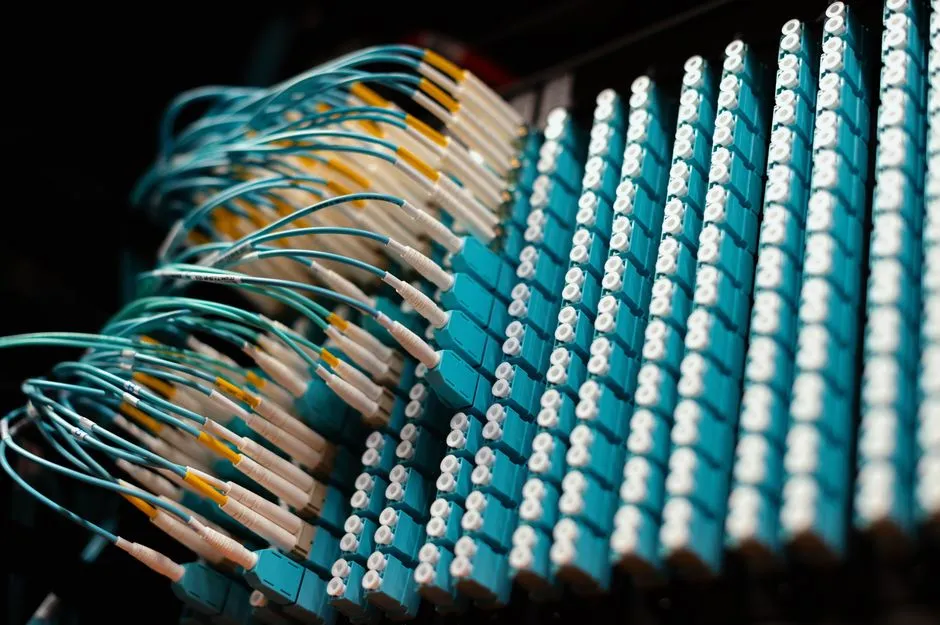
Unlike the rare earths that dominate trade coverage, erbium is not a magnet material. It is the dopant in an erbium-doped fibre amplifier, a device that boosts an optical signal without converting it back to electricity. Every long-haul link and every subsea cable depends on amplifiers of this kind spaced along the route. Yttrium goes into ceramic capacitors, solid-state lasers, microwave filters, white LEDs and displays.
China mines about 90 per cent of the world's yttrium and processes all mined yttrium ore into usable yttrium oxide. It supplies all erbium oxide. Across rare earths generally it accounted for about 60 per cent of mining output in 2024 and 91 per cent of global separation and refining.
The constraint is already binding
Most of the attention is on a date in November, and that framing gets the situation backwards. The controls announced in October 2025 — the ones carrying the extraterritorial rule for products made with Chinese-origin rare-earth content — were suspended for twelve months in November 2025, and Beijing decides around 10 November 2026 whether to reinstate them, extend the suspension or let them lapse.
Those measures are not what has cut yttrium exports by three quarters. The April 2025 licensing regime was never suspended, and it is doing the work on its own. That 75 per cent fall is the observable output of the policy currently in force, not a warning about a future one.
The practical difference matters for anyone planning around it. A cliff in November can be prepared for by pulling purchases forward. A licensing regime that is already throttling volume cannot be, because the shortfall has been accumulating for most of a year and has already drawn down the inventory that would have absorbed it.
Why the optical layer is the exposed one
It is easy to underestimate a data centre's rare-earth dependency, because the obvious candidates are substitutable or already committed. The magnets in hard-drive motors are being phased out by the shift to flash; the magnets in cooling fans are used in small volumes.
Optical amplification has no equivalent escape. Erbium-doped fibre amplifiers work because erbium's electron transitions happen to emit in the 1,550 nanometre window, which is the wavelength band where silica fibre is most transparent. That coincidence is why the C-band became the standard for long-haul transmission, and it is not a design choice that can be reversed by picking a different supplier or a different element.
The quantities involved are tiny — an amplifier contains metres of doped fibre, not kilograms of metal. That cuts both ways. Small volumes mean a shortage takes a long time to bite, and it also means the market is too small to attract the investment that would build an alternative supply chain quickly.
What this means from Singapore
Singapore is a landing point for a large share of the subsea capacity connecting South and Southeast Asia to the rest of the world, and the region's data-centre buildout is being planned on the assumption that capacity keeps arriving on schedule. Cable systems are long-lead projects where the repeater and amplifier order sits deep inside a multi-year programme, which is exactly the position where a component constraint is discovered late.
The regional exposure is not to a price rise. Amplifier components are a rounding error against the cost of laying a cable. It is to lead time, and to the possibility that a licensing decision made in Beijing in November lands in the middle of a procurement cycle that cannot be re-planned inside a quarter.
We reported that the Johor-Singapore Special Economic Zone is being built around data-centre and AI infrastructure investment. Projects of that shape are the ones that carry the most schedule risk from a component with one national supplier.
What operators can actually check
The useful question is not whether a facility contains rare earths — everything does — but whether any single-sourced component sits on a critical path with a lead time longer than the notice a policy change would give.
For most operators that list is short: optical amplifiers and the transponder line cards that depend on them, certain classes of ceramic capacitor, and any laser subsystem. Those are the items worth asking a supplier to confirm inventory depth on, and worth asking about in the specific terms of months of cover rather than a general assurance about supply-chain resilience.
It is also worth being precise about what a reinstated control would and would not do. Export licensing restricts the movement of material out of China. It does not restrict manufacturing inside China, which means components assembled there and exported as finished goods sit in a different regulatory category than the raw oxide. That distinction, between raw material and finished goods, is the source of most of the practical uncertainty, and neither the October 2025 announcement nor its suspension has settled it.

View author profile → · Editorial policy