
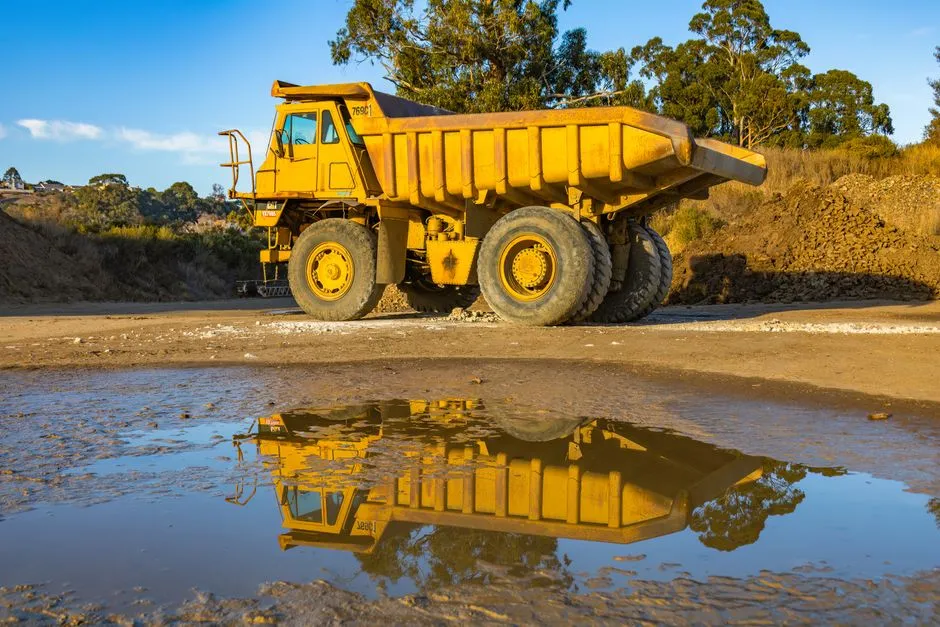
31 AUG 2026 — Caterpillar says the lessons of two decades of autonomous mining apply to deploying AI elsewhere, and is committing US$100m over five years to retrain its workforce. Its own quarterly numbers say the company's largest AI exposure is not deployment at all. It is selling generators to data centres.
What the company said
Chief technology officer Jaime Mineart argues that the hard part of autonomy and physical AI is not the technology but its incorporation into a customer's jobsite and workflows, and that the company can take what it learned from mining into more dynamic environments such as construction and quarries.
The supporting assets are substantial. Caterpillar runs autonomous haul trucks, drilling equipment, underground loaders and dozers, plus fleet management and terrain intelligence software, and reports 1.6 million connected assets globally producing 16 petabytes of structured data. A new Cat AI Assistant lets field technicians retrieve repair procedures, troubleshoot and identify parts by voice before starting work.
The number that reframes the story
Power generation retail sales rose 72 per cent in the quarter, the strongest line inside a Power and Energy segment that grew 17 per cent to US$8.2bn. Chief executive Joe Creed's summary of demand for cloud computing and AI infrastructure was that no one is slowing down, and the company's own description of the segment attributes the strength to demand for power generation equipment, particularly for data centre applications.
One figure needs care. Coverage of this has reported a 72 per cent rise to US$3.10bn, and Caterpillar's release presents the 72 per cent as a retail sales growth rate for the power generation end market rather than as revenue on a segment line. The growth rate is well supported. The dollar figure attached to it in secondary reporting is not one we could match to the release, and we have not treated the two as the same measure.
That demand is not for Caterpillar's deployed AI. It is for the reciprocating engines and generator sets that data centres buy for prime and standby power because grid capacity is too slow. On the evidence of a 72 per cent move in one quarter, the AI build-out is a much more immediate contributor to the business than any internal deployment programme.
The backlog says the same thing with a longer horizon. Caterpillar ended the quarter with US$72.1bn of orders, roughly 92 per cent higher than a year earlier, against total sales and revenues of US$20.5bn, up 24 per cent and the first quarter above US$20bn in the company's history. A backlog growing several times faster than revenue is a statement about committed future demand rather than about the quarter, and it is the number that would be hardest to explain without the build-out.
The autonomy work remains interesting, and it should be kept separate from the generator business. A company can be a serious operator of industrial AI and still take most of its near-term AI-linked revenue as an arms supplier to the build-out. The second fact is the one visible in the accounts.
What mining automation actually taught
The transferable lesson is more specific than the general observation that integration is hard.
A mine is the friendliest possible environment for autonomy, and that is why it went first. The site is private, the routes are fixed, the traffic is entirely fleet-owned, the pedestrians have been trained and inducted, and the operator controls the road surface. The property line removes almost every variable a public road throws at an autonomous system.
So twenty years of mining autonomy proves the control problem is solvable when the environment is controlled. It does not prove the same system works on a construction site, which has subcontractors, deliveries, changing ground, unfixed routes and people who did not read the induction. Mineart's phrase for the target is more dynamic environments, and the dynamism is the entire difficulty.
The transferable part is the operational apparatus around the machine: remote supervision centres, exception handling when the vehicle stops and will not proceed, maintenance scheduled from telemetry, and retraining operators into supervisors. It is unglamorous, and it is the part most AI deployment programmes underbuild.
Connected assets are not a deployment
The figures of 1.6 million connected assets and 16 petabytes of structured data measure a prerequisite rather than an outcome.
Telemetry from a machine is a stream of engine hours, fuel burn, fault codes, position and load. Having a great deal of it establishes that the fleet is instrumented, which is the necessary first condition and the one most industrial firms have not met. It says nothing about whether the data is being used to decide anything, and the gap between an instrumented fleet and a fleet whose maintenance schedule is actually driven by its own telemetry is where most industrial analytics programmes stall.
Structured is doing work in that sentence too, and to Caterpillar's credit. Structured data has been parsed into fields with known meaning, which is a much stronger claim than a volume of logs, and it is the difference between a warehouse you can query and an archive you can only search.
The training number is the honest signal
US$100m over five years across 118,000 employees is about US$170 per employee per year.
That sounds substantial as a headline and modest when divided out, and both readings are useful. It is not enough to retrain a workforce into AI practitioners, and it was never meant to be. It is enough for structured familiarisation at scale: the realistic goal is that a technician can use an assistant correctly rather than build one.
Read that as a company being sober about what deployment requires. The constraint on physical AI is rarely the model, and it is very often that the person at the machine has not been given a workflow that assumes the tool exists.
Why this matters for the region's operators
Mining, palm oil, construction and port handling across ASEAN run the same equipment on much thinner margins, and the sequencing lesson is the transferable part.
An operator in Kalimantan or Sarawak evaluating autonomy should read the mining record as encouraging for controlled sites and silent about everything else. The question for a vendor is not what the system can do. It is what happens when it stops. Who supervises it remotely, over what connection, at what hour, and how long does the machine sit idle waiting for a human decision?
The same reasoning applies to the power side. We reported that Malaysia's 6GW data centre pipeline is announcements rather than connections, and a 72 per cent jump in generator sales is what that gap looks like on a supplier's income statement.