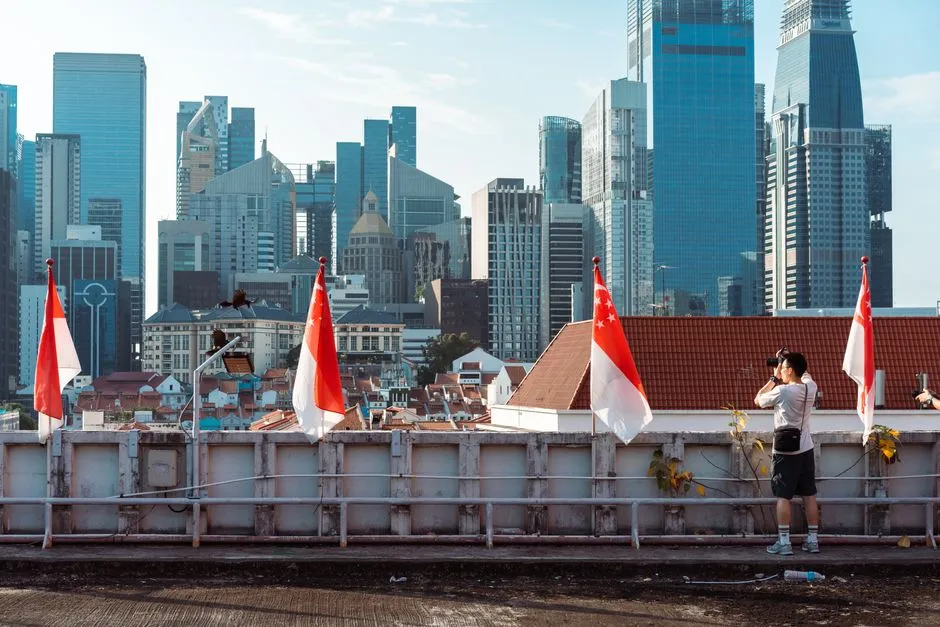
Singapore AI Week opens on 8 June with a clear pitch: in an AI industry being pulled apart by export controls and rival sovereign-AI agendas, the city-state wants to be one venue where US, Chinese, European and regional AI players can still appear on the same calendar. The week's anchor — the SuperAI conference, running 10–11 June at Marina Bay Sands — is built around that "neutral ground" proposition. The timing is hard to ignore: barely a week earlier, on 31 May, the United States tightened chip-export enforcement aimed at China-parented firms wherever they operate — guidance that, in the reporting around it, has put overseas subsidiaries routed through hubs such as Singapore and Malaysia under fresh scrutiny. The same geography that makes Singapore attractive as neutral ground is what now draws that scrutiny to it.
The pitch, and who is buying it
SuperAI's organisers are explicit that the event exists to capitalise on Singapore's in-between position. Co-founder Peter Noszek frames the city-state as the only place where "the full spectrum of global AI comes together in one room." The 2026 edition is scaling accordingly: organisers say they expect more than 10,000 attendees, 1,500 AI companies and over 150 speakers from upwards of 150 countries — figures that are pre-event projections rather than audited counts, and a marked step up from the 7,000 who attended the sold-out 2025 edition. The exhibitor list is itself the argument, placing Chinese players such as Alibaba Cloud and robotics maker Unitree alongside Western labs and infrastructure firms.
The framing is not just marketing. A Reuters analysis in April reported Singapore shifting from an East-West "gateway" to neutral ground for AI, as Chinese startups seek to operate beyond Beijing's reach and US firms chase talent without visa friction. But the same piece carried the counter-risk in the words of NUS political scientist Chong Ja Ian, who warned that Singapore could come to be seen as a "grey space for technology transfers" that one or both governments move to restrict. That tension — hub versus conduit — runs through the entire week.
The substance behind the slogan
What gives the neutral-ground pitch weight is that real money and infrastructure have been arriving, mostly through the government track rather than the conference floor. At the IMDA-hosted ATxSummit on 20 May, Singapore landed a cluster of commitments. OpenAI signed its first memorandum of understanding with the Singapore government, branded "OpenAI for Singapore", backed by more than S$300 million (about US$234 million) and anchored by the company's first Applied AI Lab outside the United States, with more than 200 technical roles planned — confirmed by the MDDI and OpenAI announcements. Nvidia committed to a Singapore AI research lab focused on robotics and AI infrastructure, and Google expanded a national AI partnership toward agentic-AI deployment across local enterprises.
These sit on top of a deliberate state strategy. Singapore's National AI Strategy 2.0, launched in December 2023, pledged more than S$1 billion over five years; a National AI Council chaired by Prime Minister Lawrence Wong was established in February 2026; and the government has committed over S$1 billion to public AI research from 2025 to 2030. The investment is buying adoption as much as research — Singapore consistently ranks among the world's heaviest per-capita users of frontier AI tools. For a country without a frontier AI-chip champion of its own, and with a population smaller than many Chinese cities, convening power and deployment have become the comparative advantage.
The squeeze
The pressure point came on 31 May, when the US Bureau of Industry and Security issued weekend guidance clarifying that advanced AI accelerators — Nvidia's Blackwell and Rubin families and AMD's MI350x — require an export licence when destined for any company whose ultimate parent is headquartered in China, regardless of where the buying subsidiary sits. Crucially, BIS framed this as reaffirming a parent-company test that has technically existed for years rather than inventing a new rule; reporting, first by Reuters, described it as closing a gap that for roughly a year let Chinese-linked firms buy restricted chips through subsidiaries in Southeast Asia and the UAE. The South China Morning Post cited sources estimating hundreds of thousands of servers moved through that gap.
The important distinction is that the guidance targets China-parented buyers and their subsidiaries, not Singapore as a jurisdiction; the risk for Singapore is reputational and compliance-related, not an allegation of state misconduct. Nvidia, for its part, says the clarification changes nothing about its conduct: a company spokesperson told Al Jazeera that "licences are required to ship controlled products to PRC-headquartered companies," consistent with its existing vetting. The company has also pushed back on the assumption that chips billed to Singapore are diverted to China, noting many customers use Singapore entities for products ultimately bound for Western markets. But the episode makes the structural risk concrete: the more successfully Singapore convenes both blocs, the more both blocs will police what flows through it.
What it means for the region
For Southeast Asia, Singapore is running an experiment the rest of the region is watching. Singapore, Malaysia and Indonesia together host one of the world's densest data-centre clusters, and the neutral-ground model — court everyone, take sides with no one — is the template ASEAN governments have broadly favoured. The 31 May guidance is a reminder that the model has limits set in Washington and Beijing, not in the region. Malaysia's Johor, cited in reporting on the same chip-routing issue, faces a sharper version of the same question. The upside, if Singapore can hold the line, is a regional AI hub that gives enterprises across ASEAN access to frontier tools and talent without forcing them to pick a camp; the downside is that "neutral" infrastructure becomes a compliance liability the moment a superpower decides it has been used as a back door.
Key Takeaways
Singapore AI Week (8–14 June) and its anchor SuperAI (10–11 June, Marina Bay Sands) are built around positioning Singapore as "neutral ground" for a fragmenting global AI industry; organisers project 10,000+ attendees (vs 7,000 in 2025).
The pitch is backed by real commitments announced at ATxSummit on 20 May: OpenAI's >S$300m "OpenAI for Singapore" and first overseas Applied AI Lab, plus new Nvidia and Google partnerships.
On 31 May, US BIS guidance clarified that advanced AI chips need a licence for any China-parented firm wherever located, with reporting citing Singapore and Malaysia as routing hubs for China-parented buyers — sharpening the compliance and reputational risk to Singapore's neutral position, though the rule targets entity ownership, not Singapore itself.
For ASEAN, Singapore is testing the region's preferred "court everyone" model against limits set in Washington and Beijing.