Disclosure: RECATOOLS is written with the assistance of Claude, made by Anthropic, whose OSS Scanner Drupal credits with discovering the flaw in this story. Readers should weigh that interest.
25 NOV 2026 — Attackers exploited a flaw in the installer of the Drupal content management system on live sites about a day after the fix was released, according to a report the Drupal Security Team says it received. The US Cybersecurity and Infrastructure Security Agency (CISA) added the flaw, CVE-2026-132165, to its Known Exploited Vulnerabilities catalogue on 24 November and set a 27 November deadline under BOD 26-04, its directive to US federal civilian executive branch agencies.
The team's advisory, SA-CORE-2026-017, rates the flaw "Highly critical", at 20 out of 25 on its own scale. "Under specific conditions, an attacker can use the installer to attempt to reinstall Drupal," it says. "This can lead to a site takeover or remote code execution." An update added to the advisory reads: "the Security Team has received a report this was exploited on live sites as early as 2026-11-19 19:00 UTC."
What to do now
Upgrade to the release for your branch: 11.4.13, 11.3.22 or 10.6.22. Also block access to the installer, /core/install.php, on every installed site, upgraded or not. Drupal’s security team recommends this, and the advisory gives it as the stopgap for a site that cannot be upgraded immediately. Drupal 11.2 and below, 10.5 and below, and Drupal 8 and 9 are past their end of life and get no fix. Drupal’s guide to securing the installer, linked below, gives rules for Apache, Nginx and .htaccess, and warns against blocking update.php by accident. The advisory lists no signs of compromise to check for.
From patch to attack
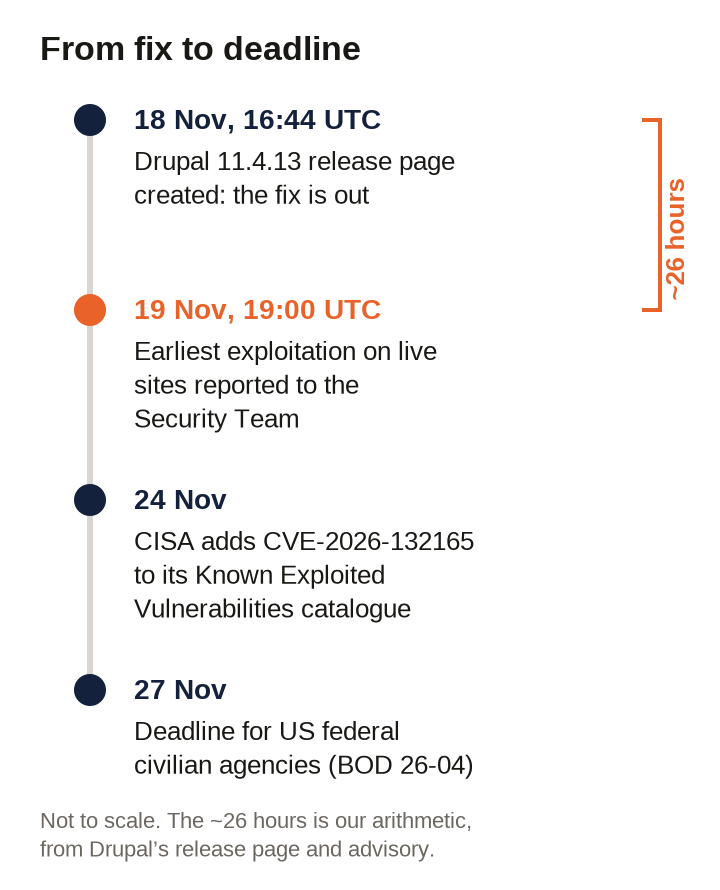
The 10.6.22 and 11.3.22 release pages followed the same day, by 17:06 UTC. Measured from the creation of the 11.4.13 release page, a little over 26 hours separate the fix from the first reported attack.
This entry's three-day deadline is the most common one this year: by our count from the catalogue's 24 November version, 171 of the 311 entries CISA has added in 2026 have one, and two have a shorter one. CISA has also marked this entry for forensic triage, and its required action cites the agency's "Forensics Triage Requirements" alongside BOD 26-04.
This is the sixth Drupal core flaw in the catalogue and the second added in 2026, after a SQL injection flaw (CVE-2026-9082) in May.
Which versions are fixed
The advisory lists as affected every version numbered below 10.6.22, Drupal 11.0 to 11.3 below 11.3.22, and 11.4 below 11.4.13.
| Branch | Fixed in | Security coverage |
|---|---|---|
| 11.4.x | 11.4.13 | Until April 2027 |
| 11.3.x | 11.3.22 | Until December 2026, when Drupal 11.5.0 is released |
| 10.6.x | 10.6.22 | Until December 2026, when Drupal 11.5.0 is released |
| 11.2.x and below, 10.5.x and below, Drupal 8 and 9 | No fix | End of life |
Shutting the installer
For sites that cannot upgrade at once, the advisory points to Drupal's guide on securing the installer. "You need it once, to install the site," the guide says. "After installation is complete, you should block access to it." It warns against blocking too much: "update.php is a separate script."
The advisory adds that "some (but not all) exploit paths are mitigated if the web server cannot write to or change permissions on settings.php", and recommends securing the installer in addition to upgrading. Sites that use Drupal Steward "are already protected from known attack vectors", it says, though they should still upgrade.
The same releases fix a second issue, SA-CORE-2026-018 (CVE-2026-132166), rated "Moderately critical". It is a "gadget chain" that could help an attacker reach remote code execution only if a separate flaw already lets them pass untrusted data to deserialisation, and the advisory says it "is not directly exploitable".
The advisory credits the discovery to "Anthropic's OSS Scanner". When we checked at 23:32 UTC on 24 November, the US National Vulnerability Database had no record of CVE-2026-132165.

View author profile → · Editorial policy
Go further
More from Cybersecurity

CISA Lists Exploited Puppet Enterprise Flaw That Lets Any Signed Agent Run Code on the Server

Oracle's November Patch Fixes 11 Java Flaws, All Remotely Exploitable Without a Login, Oracle Says

Singapore Warns Attackers Are Reportedly Exploiting an Apache Web Server Flaw Present Since 2023

Osaka Says 1.08 Million Email Addresses Leaked as Arara Breach Count Reaches 81 Million