Lightning Distance Calculator
Lightning distance calculator. Estimates how far away a strike was from the seconds between flash and thunder, using the speed of sound in your air, and explains what became of the 30-30 rule. Educational aid.
Lightning Distance Calculator
How to use the lightning distance calculator
Count the seconds
Start counting at the flash and stop at the first thunder from it. The first rumble comes from the nearest part of the lightning channel; the US National Weather Service notes that as you keep listening you hear “the portions of the channel farther and farther away.”
Enter the count and the air
Type the seconds. The temperature and humidity start at Singapore’s averages from the Meteorological Service Singapore (MSS); change them if you know your own air. Above 30 °C the calculator says its speed of sound is extrapolated, because the NPL formula it uses is stated for 0–30 °C.
Read the distance
The answer is in kilometres first, then miles. Beside it are what the “divide by three” rule would have said for the same count, and how far one second of miscounting moves the answer.
Read the band as history, not a rule
The result marks whether the count was under 30 seconds, the line the 1998 “30-30 rule” drew. That first “30” was later replaced by “When Thunder Roars, Go Indoors”; the result quotes the current wording from the National Weather Service and MSS rather than giving advice of its own. Past about 46 seconds in Singapore air it gives no distance at all (see below).
Flash-to-bang — how far away is the lightning?
Light is instant; sound depends on the air
The Hong Kong Observatory puts it simply: light, at “around 300,000,000 meters per second”, travels much faster than sound, “which moves at 340 meters per second”, so the delay between flash and thunder is almost entirely the sound’s travel time. How fast the sound travels depends on the air. This calculator uses the UK National Physical Laboratory’s implementation of Cramer’s 1993 equation for sound in humid air. In dry air at 20 °C it returns 343.36 m/s, which is where the textbook 343 m/s comes from. In Singapore’s average air, 27.8 °C and 82% humidity, it returns 349.6 m/s: sound covers a kilometre in 2.86 seconds, not three.
That makes the familiar rules approximations. Dividing by three for kilometres (the Hong Kong Observatory’s rule) implies 333.3 m/s, and in that air it reads 4.6% short. Dividing by five for miles (the National Weather Service’s rule) implies 321.9 m/s and reads 7.9% short. Even the textbook 343 m/s reads 1.9% short. A 30-second count is 10.5 km in Singapore’s average air; the three-second rule says 10 km. Each of these errors puts the strike closer than it was.
The count matters more than the weather
One second of miscounting moves the answer by about 350 m in that air. For any count under 21.5 seconds, a single second’s miscount is a bigger error than the three-second rule’s temperature bias; for the five-second mile rule the crossover is 12.6 seconds. The authors of the 30-30 rule said as much. The 1998 Lightning Safety Group wrote that this way of ranging “has severe limitations in part due to the difficulty of associating the proper thunder to the corresponding flash” (Holle, López and Zimmermann, 1999).
“The lightning safety community now recommends seeking a safe place when you hear thunder, rather than the previous guidance of the first ‘30’ of the ‘30-30 Rule’.” — William P. Roeder, “Recent changes in lightning safety”, AMS annual meeting, January 2008
Thunder carries about ten miles, so long counts are suspect
The National Weather Service says thunder “can be heard for a distance of only about 10 miles from the lightning strike”, and that “traffic, wind, and precipitation may limit the ability to hear thunder to less than 10 miles.” Sound in Singapore’s average air takes 46 seconds to cover 10 miles (16.1 km). Past the count that matches 10 miles in the air you entered, the calculator gives no distance. A count that long more likely pairs one flash with another strike’s thunder.
The 30-30 rule: written in 1998, half-replaced by 2008
The rule comes from the Lightning Safety Group’s 1998 meeting, published by Holle, López and Zimmermann in 1999: “The first 30 refers to the number of seconds between ‘flash’ and ‘bang’ that initiates safety precautions. The second 30 refers to the number of minutes after the last flash or thunder in order to establish an all clear signal.” Below 30 seconds, they wrote, a person “should be in, or seek, a safer location”.
The first half did not last. William Roeder’s paper to the American Meteorological Society’s January 2008 meeting records that “many people were remembering this as ‘go to a safe place at this time’, not ‘be in a safe place’”, and that the National Weather Service’s Lightning Safety Awareness Week working group adopted “When Thunder Roars, Go Indoors!” The change came from discussions and consensus over 2006–2007, not from a dated rule, so it has no single effective date. The second half survived: the National Weather Service still says to “wait 30 minutes after the last lightning or thunder before going back outside.” The replacement is not universal either. A National Weather Service office page in Shreveport still taught the 30/30 rule when we checked in October 2026.
What the weather services in Singapore and Malaysia say
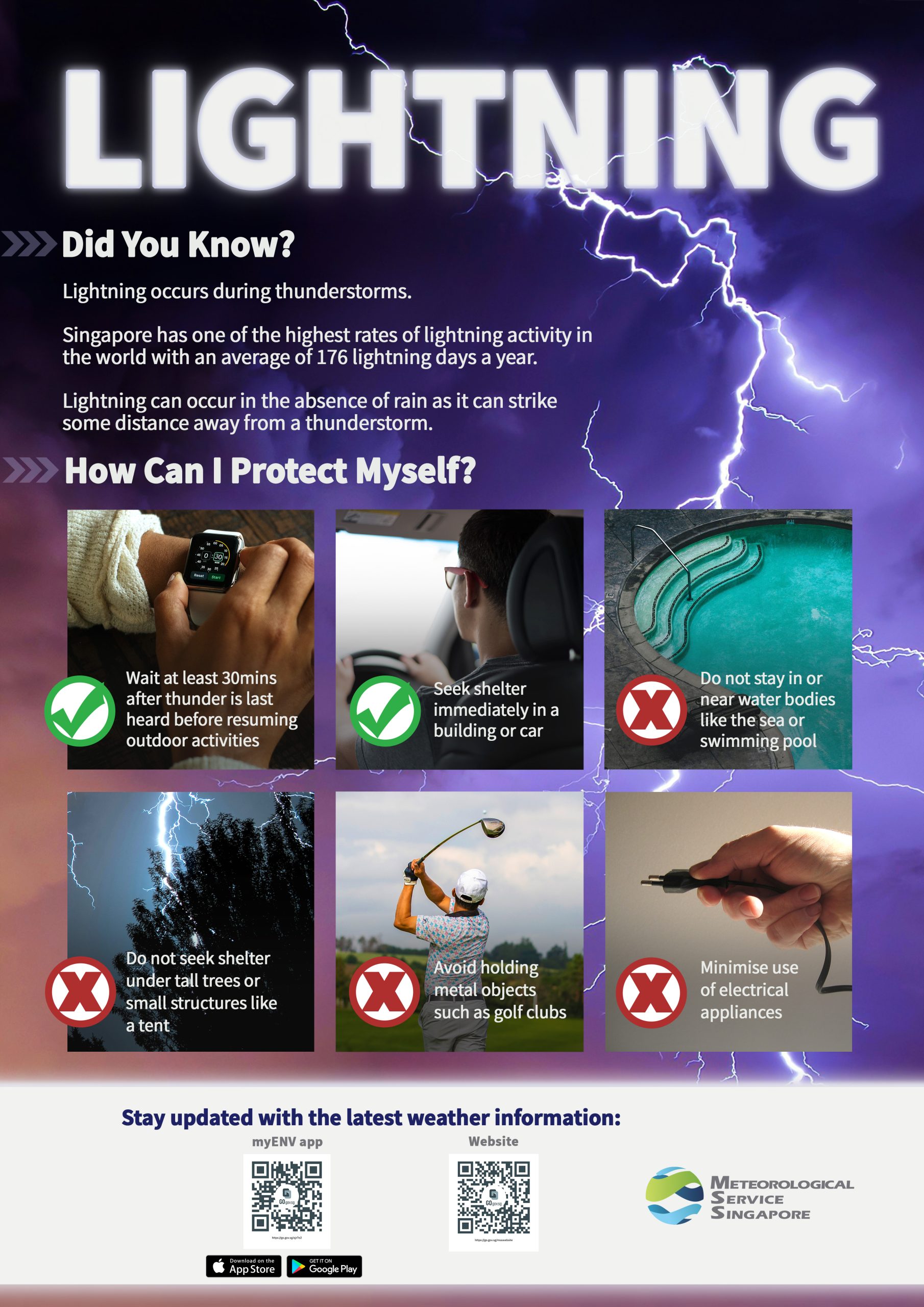
Neither teaches a seconds count. MSS says Singapore averages about 176 lightning days a year, “one of the highest” lightning rates in the world, that “most lightning strokes occur within 5-6 km of a thunderstorm cloud”, and that strokes from a cloud “more than 10 km away” can still reach a location. Its lightning poster says to “seek shelter immediately in a building or car” and to “wait at least 30mins after thunder is last heard before resuming outdoor activities”. The Malaysian Meteorological Department says lightning “can occur as far as 10 miles away from the rain area”. For people caught outside it advises them to “squat down on the ground”. The US lightning safety community stopped teaching that kind of “last minute outdoor lightning risk reduction” to general audiences in 2008 (Roeder). The two positions differ, and this page reports both rather than choosing.
Thunder in Singapore air, a half-retired rule and a ten-mile ceiling
In Singapore’s average air sound covers a kilometre in 2.86 seconds (349.6 m/s, NPL/Cramer).
The ÷ 3 km rule reads 4.6% short in that air; the ÷ 5 mile rule reads 7.9% short.
343 m/s is dry air at 20 °C (343.36 by NPL’s calculator).
One second of miscounting is about 350 m: more than the ÷ 3 rule’s error below 21.5 seconds.
NWS: thunder is heard “only about 10 miles” away — 46 seconds of travel here.
The 1998 Lightning Safety Group said flash-to-bang ranging “has severe limitations”.
The 30-30 rule dates from 1998; its first “30” was replaced after a 2006–07 consensus.
The 30-minute wait survived: NWS and MSS both still give it.
MSS: Singapore averages about 176 lightning days a year.
MSS: most strokes fall within 5–6 km of a thunderstorm cloud.
Frequently asked questions
Multiply the seconds between the flash and the thunder by the speed of sound in the air you are in. The calculator works that speed out from the temperature and humidity you enter. In Singapore’s average air it is 349.6 m/s, so a ten-second gap is about 3.5 km. Dividing by three for kilometres or by five for miles is a quick approximation; in that air the first reads 4.6% short and the second 7.9% short.
Light arrives almost at once and sound does not. The Hong Kong Observatory gives light “around 300,000,000 meters per second” against sound’s “340 meters per second”, so nearly all of the delay is the sound’s travel time. Multiply that time by the speed of sound and you have the distance to the part of the lightning channel nearest you.
A lightning-safety rule from the 1998 Lightning Safety Group, published by Holle, López and Zimmermann in 1999. The first 30 was a flash-to-bang delay of 30 seconds, below which a person “should be in, or seek, a safer location”. The second was a 30-minute wait after the last flash or thunder. Roeder (2008) records that the National Weather Service’s Lightning Safety Awareness Week working group replaced the first half with “When Thunder Roars, Go Indoors!” after discussions and consensus over 2006–2007, partly because people remembered it as “go to a safe place at this time”. There was no single effective date. The 30-minute wait is still current, and one National Weather Service office page, Shreveport’s, still taught the whole 30/30 rule when we checked in October 2026.
It means the last strike was far away, not that the next one will be. The National Weather Service says “lightning can strike outward 10 miles from a thunderstorm”. MSS says strokes from a cloud “more than 10 km away” can still reach a location, which it calls a “bolt from the blue”. The current guidance from both agencies keys on hearing thunder, not on the length of the gap.
The count is the weak point, not the air. One second of miscounting moves the answer by about 350 m, which for counts under 21.5 seconds is more than the three-second rule’s temperature error. Pairing the wrong thunder with a flash is worse: the 1998 Lightning Safety Group warned that the method “has severe limitations in part due to the difficulty of associating the proper thunder to the corresponding flash”. The distance is also to the nearest part of the channel, which is not necessarily where the bolt reached the ground. The calculator does not model wind.
Because the National Weather Service says thunder “can be heard for a distance of only about 10 miles from the lightning strike”, and sound in Singapore’s average air takes 46 seconds to cover 10 miles. The exact limit moves with the air you enter: colder air carries sound more slowly, so the limit is a little longer. A count beyond it more likely matches one flash with another strike’s thunder, so the calculator says so instead of printing a distance.
Yes, and the calculator uses it. It follows the NPL implementation of Cramer’s 1993 equation, which also includes humidity. The speed is 343.36 m/s in dry air at 20 °C and 349.6 m/s at Singapore’s average 27.8 °C and 82%. NPL states its calculator is valid from 0 to 30 °C, so above or below that the result is marked as extrapolated. In dry air the extrapolated values stay within 0.14 m/s of the ideal-gas formula from −10 to 45 °C (our check).
This page quotes them rather than advising. The National Weather Service: “When Thunder Roars, Go Indoors.” MSS’s lightning poster: “Seek shelter immediately in a building or car.” The Malaysian Meteorological Department tells people caught outside to “squat down on the ground”. The US lightning safety community stopped teaching that kind of last-minute outdoor measure to general audiences in 2008 (Roeder). MSS also runs a Lightning Information Service that maps strokes from the last 30 minutes, with alert rings of 6 or 8 km.
No. The values you enter are processed entirely in your browser. Nothing is sent to a server, stored, or shared, and no account is required. The calculation runs on your device only.
Sources
- National Physical Laboratory (UK), “Calculation of speed of sound in humid air” (archived 13 Dec 2024), implementing Cramer O, J. Acoust. Soc. Am. 93, 2510 (1993).
- Holle RL, López RE, Zimmermann C. Updated recommendations for lightning safety—1998. Bull. Amer. Meteor. Soc. 1999;80(10):2035-2041.
- Roeder WP. Recent changes in lightning safety. Paper P2.14, Third Conference on Meteorological Applications of Lightning Data, AMS 88th Annual Meeting, January 2008.
- US National Weather Service: thunder, lightning science overview, lightning and sports, lightning safety, safety overview; NWS Shreveport, lightning safety.
- Meteorological Service Singapore: Climate of Singapore (1991–2020 station means), Weather systems, lightning poster, Lightning Information Service.
- Hong Kong Observatory, “Why does lightning always come before thunder?”
- Malaysian Meteorological Department, weather phenomena.
Pick up where you left off
Stored only in this browser — never sent to our servers.